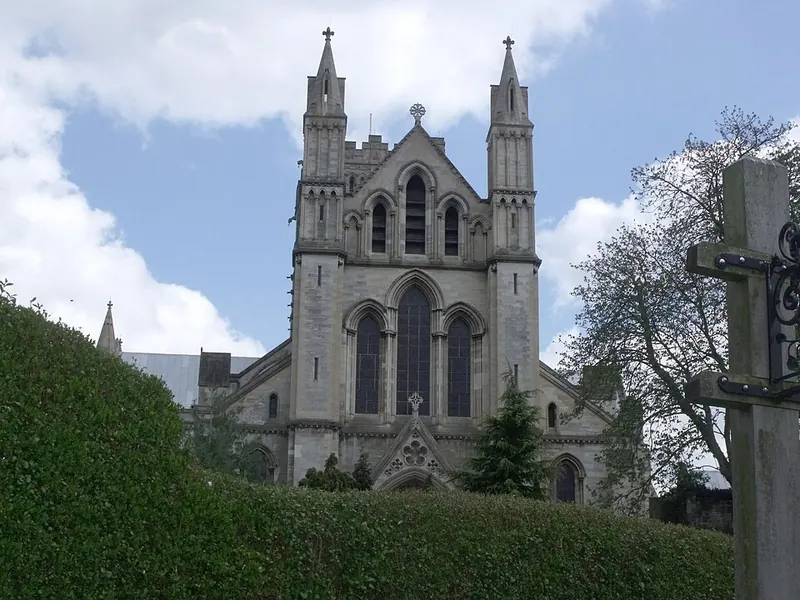
Mass times this week
Regular weekly timetable
Mon
- 10:00
Tue
- 10:00
- 17:30
Wed
- 07:30
- 10:00
Thu
- 10:00
Fri
- 07:30
- 10:00
Sat
- 18:00 Vigil
Sun
- 09:00
- 11:00
- 15:00
- 17:30
Services with timing to confirm
These source labels need parish confirmation before they can be placed on a date.
See Mass times at the 6 other churches in Norwich →
Parish schedules can change on holy days of obligation.
We do not hold the page these times were published on, so we cannot show you when they were last confirmed. Mass times may change; check with the parish before travelling.
Confession Times
- Sunday
- 4:45pm – 5:15pm
- Tuesday
- 6pm – 6:30pm
- Saturday
- 10:30am – 11am
- Saturday
- 5:15pm
Adoration & Devotions
Rosary
Monday 10:40am
Rosary
Tuesday 10:40am
Rosary
Wednesday 10:40am
Rosary
Thursday 10:40am
Rosary
Friday 10:40am
Solemn Vespers and Benediction
Sunday 4:30pm
Adoration
Tuesday 6pm – 6:30pm
Adoration
Saturday 10:30am – 11am
Adoration
Friday 10:40am until Benediction at 4pm (First Friday of the Month only)
Opening Times & Private Prayer
Daily 7:30am – 6:00pm
Information sources
About Cathedral of St. John The Baptist
Cathedral of St. John The Baptist is a Roman Catholic church in Norwich, Norfolk. It is part of the Diocese of East Anglia.
Introduction
The Cathedral of Saint John The Baptist in Norwich was built between 1882 and 1910 to the design of George Gilbert Scott, junior, and John Oldrid Scott. The church was first listed at Grade I on 26th February 1954 and designated as the Cathedral Church of St John the Baptist for the Diocese of East Anglia in 1976.
History
In October 1878 the 15th Duke of Norfolk wrote to Bishop Amherst of Northampton expressing a wish to build a larger church for the Catholics of Norwich. The church was fully opened on 8th December 1910 and dedicated to St John the Baptist.
The church was originally built as the parish church of Norwich, the generous gift to the Catholics of Norwich of Henry, Duke of Norfolk fulfilling a vow made on pilgrimage. The church remained a simple parish church until 1976, when by the command of Pope St Paul VI, it became the Cathedral Church of the Diocese of East Anglia.
Architecture and furnishings
The cathedral is cruciform in plan with chapels projecting eastwards from both transepts and a sacristy at the end of the south transept which abuts Cathedral House. The interior is vaulted throughout, quadripartite in the nave and aisles, tierceron in the transepts, crossing and sanctuary and with Hoptonwood stone flooring. The crossing tower is of three stages with slim clasping buttresses at the corners. The carved beam and rood of 1910-1911 installed by Robert Bridgeman and Sons of Litchfield and Peter Rendl of Oberammergau, possibly to a design by JO Scott, spans the chancel arch.
The organ installed in 1903 is in the south transept's eastern aisle. The three large lancets in the north end, collectively called the Queen’s Window, were designed by Dunstan Powell and JO Scott and renewed by Adrian Gilbert Scott following wartime damage in 1942. The cathedral is built of Beer stone, Pennine Gritstone and clunch over a brick core with Frosterley marble details and lead roofs. The west front is set between turrets with blind arcading on the upper stages topped by spirelets, and the main door is deeply recessed in a gabled porch flanked by blind arches.
The aisled nave has 10 bays divided by buttresses which rise to flying buttresses on the clerestorey topped by finials and with a single lancet window in each bay. The south transept is of three bays with tall, plain lancets on the east side above St Joseph’s Chapel and the Sacristy vestibule, and its southern gable end has five lancets and a wheel window with a spirelet at one corner. The north transept has three tall lancets flanked by buttresses with statue niches on the north end and the two-storey apsidal-ended Walsingham chapel projecting from the east side.
Below the east end is a columbarium of four bays with quadripartite vaulting in clunch, entered from ramped, walled walkways through portal arches of Pennine Gritstone. The windows, doors and arcading are all in the lancet style with hood mouldings and stone or Frosterley marble shafts with the exception of the nave and Sanctuary arcades which rise from large drum columns. The vaulted north porch has timber doors with elaborate ironwork under an arch with a band of carved figures, and beside the porch is the entrance to the sunken Baptistry with original wrought iron gates.
Eight bays of the nave have benches with built-in kneelers and simple flat-topped ends set on late C20 timber platforms and more are found in the transepts. Blind arcading in six bays of the south aisle is broken by projecting piers with clusters of marble shafts flanking a single fluted shaft rising to the vaulting. The eastern four bays of the south aisle are an arcade open to the sunken St Joseph Chapel, originally a memorial chapel to the Duchess of Norfolk who died in 1887. The Sacristy has a timber panelled ceiling, wood block floor and partition walls enclosing the Principal Sacristy and Service Sacristy, with the Choir Sacristy at the east end.
The north transept has blind arcading at ground and triforium level with deeply set double arches on the east side, simple single arches on the west. The crossing tower has blind arcading at triforium level with small, simple lancets above between clustered stone shafts rising to dramatic vaulting which frames a timber trapdoor to the belfry decorated with tracery. The sanctuary has four-bay arcades to north and south with plain drum columns, the easternmost embellished with marble shafts. Above the western gallery are three lancets containing a crucifixion scene flanked by Moses bearing the Commandments and the prophet Elijah.
The main west doors have metal framed, cast glass inner doors designed by Russell Taylor Architects in 2006. The second bay from the north porch door contains a picture of Our Lady of Czestochowa and a stone memorial plaque erected in 1982 to the memory of Polish men and women who died in the Second World War.
Music and liturgy
The cathedral has an unbroken tradition of choral singing since it was consecrated. Choral Scholarships are open to those in Sixth Form, Undergraduates, Postgraduates, and recent graduates living in the local area. Choral Scholars receive training in singing Gregorian chant as well as regular experience in providing a high standard of choral singing with a wide repertoire. Scholars are expected to sing alongside the Lay Clerks for Masses on Tuesday evenings and Sundays, as well as sing for Vespers, and to give a recital at least once a year.
The cathedral's confessionals are in the south transept, to the right of the high altar. At the Cathedral, it is not possible to have recorded music at funerals; music is chosen in consultation with the priest, and an organist and, if desired, a cantor are provided. The cathedral's cantors have a widely-ranged repertoire of sacred music appropriate for funerals, and secular music is not offered at funeral ceremonies in the Cathedral itself. A full choir is available for funerals if desired.
The cathedral's music group has worked with the Cathedral Choir and has provided music at weddings and funerals. The cathedral's music group includes guitar, bass, violins, clarinet, and recorder. The Bradford Computing Organ was upgraded and rebuilt by Phoenix Organs, redesigned to better support the development of music and the whole congregation.
Parish life
The Schola Cantorum of Lay Clerks and Choral Scholars was set up in 2016 to enhance the musical development of the Cathedral. The cathedral has been linked to its twinned parish of Tambogrande, Peru since 1974. Since 2010 the cathedral has supported workers in the Fe Y Alegria 48 network providing free education to children in 30 settings.
The cathedral has an active CAFOD group working to raise awareness and funds for CAFOD. The Justice and Peace Group covers the whole Catholic community in Norwich, all city parishes. The local St Vincent de Paul Society meets weekly in the Narthex and is involved in the practical needs of the poor and deprived in the city. Hospital volunteers help the Catholic Chaplain with pastoral care of those in hospital.
The cathedral has a Charismatic Prayer Group that meets to praise and worship God, share and discuss the Word of God, and pray for each other and people’s intentions. The Daytime Prayer Group meets on Monday mornings term-time, praying scripture, the rosary, and interceding for the needs of the local community and the Church. The cathedral offers a Ministry of listening and prayer for parishioners in need. Network for a Better World is a 'sending' charity affiliated to the Catholic Missionary Union, working with a parish in Southern Malawi run by the Montfort Order.
Catenians are local Catholic businessmen meeting socially on a regular basis, also helping to provide some practical support for Catholic purposes. Membership of the Duckett Lending Library is free to Cathedral parishioners, members of the local community and the Diocese of East Anglia.
Sacraments and pastoral care
The marriage preparation includes a four-week long course in the parish with the priests and a team of adult catechists. A full day of catechesis and marriage life skills is also required, booked directly with the Diocese. If one partner is not baptised, a Nuptial Blessing without Mass is the only possibility. The NNUH has its own chaplaincy, including a duty Catholic priest chaplain and a team of Catholic volunteers.
Visiting
Tower tours climb 230 steps up a spiral staircase to the top of the tower for 360 degree views of Norwich. Tower tours include a stop at the crossing balcony to view the transept and nave from above. The tower is the highest point in the city accessible to the public. The meeting point for tower tours is in the Rotunda, in the Narthex.
Pre-booked private tours can be arranged throughout the year. The cathedral has a shop selling unique gifts, cards, religious items, and souvenirs.
The Duckett Library is a lending library located off St Joseph’s Chapel in the South Aisle of the Nave. The cathedral offers guided lessons for schoolchildren from Key Stage 1 to 5. The cathedral's steps and pillars contain hundreds of small fossils, mainly crinoid fragments and rugose corals, within Frosterley Marble. The cathedral's main structure features Jurassic limestone, while carvings and mouldings are made from Beer stone.
Sources for this profile
- Roman Catholic Cathedral of St John the Baptist, Non Civil Parish - 1051299 | Historic EnglandRetrieved 8 October 2026 Source text © Historic England, licensed under Open Government Licence v3.0. Summarised by RomanCatholic.co.uk.
- Welcome | The Cathedral of St John the BaptistRetrieved 29 September 2026
- Cathedral Music | The Cathedral of St John the BaptistRetrieved 8 October 2026
- Masses and Ceremonies | The Cathedral of St John the BaptistRetrieved 29 September 2026
- Funerals: Death and Mourning | The Cathedral of St John the BaptistRetrieved 8 October 2026
- Tambogrande: Our Twinned Parish | The Cathedral of St John the BaptistRetrieved 8 October 2026
- Parish Groups | The Cathedral of St John the BaptistRetrieved 8 October 2026
- Duckett Library | The Cathedral of St John the BaptistRetrieved 8 October 2026
- Marriage and Weddings | The Cathedral of St John the BaptistRetrieved 8 October 2026
- Sickness, Dying and the Housebound | The Cathedral of St John the BaptistRetrieved 8 October 2026
- Tower Tours | The Cathedral of St John the BaptistRetrieved 8 October 2026
- The Cathedral of St John the Baptist | Welcome to the Catholic Cathedral of St John the Baptist, NorwichRetrieved 29 September 2026
- History & Heritage | The Cathedral of St John the BaptistRetrieved 29 September 2026
Clergy
- Pastor Fr. Alan Hodgson
Find Cathedral of St. John The Baptist
Map location for Cathedral of St. John The Baptist
Earlham Road, Norwich, Norfolk, NR2 2PA