Mass times this week
Regular weekly timetable
Mon
- –
Tue
- –
Wed
- –
Thu
- –
Fri
- –
Sat
- –
Sun
- 08:30
Services with timing to confirm
These source labels need parish confirmation before they can be placed on a date.
Parish schedules can change on holy days of obligation.
We do not hold the page these times were published on, so we cannot show you when they were last confirmed. Mass times may change; check with the parish before travelling.
About Our Lady and St. Therese
Our Lady and St. Therese is a Roman Catholic church in Painswick, Gloucestershire. It is part of the Diocese of Clifton.
Introduction
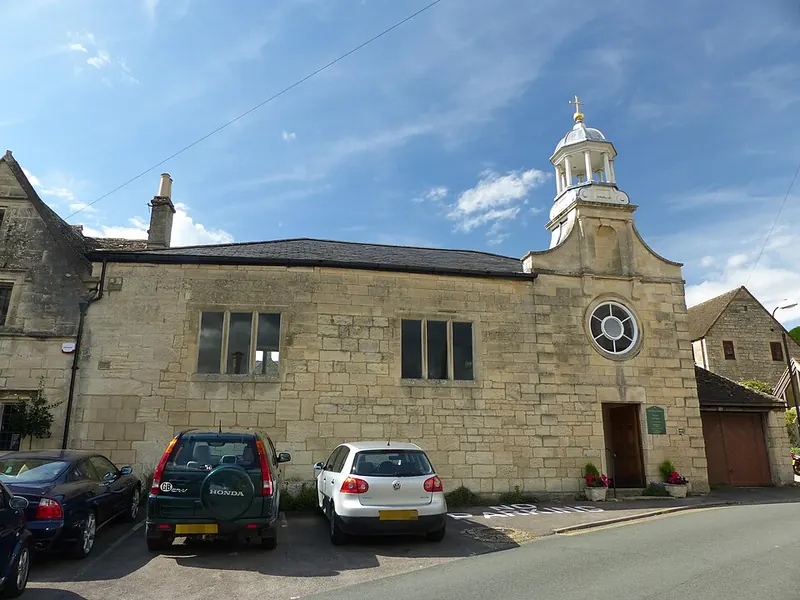
The church occupies a building that was formerly four cottages of the C16, later a slaughterhouse, converted to a place of worship in 1934.
History
In 1921, Alice Howard converted the attic of a cottage in Painswick to an oratory where Mass was occasionally said. In 1931, Miss Howard purchased the site of the present church, then a dilapidated building in Friday Street that had started life as four Tudor cottages, later becoming a slaughterhouse. Commander Henry Mowbray Howard and Jobie Swan gutted the building and cleared the dirt and rubble themselves; no architect was involved. The church was blessed by Bishop Lee on the Feast of the Assumption, 15 August 1934.
The completed church was transferred to the Diocese of Clifton in 1937. On the night of 13-14 June 1941, a stray stick of bombs fell on Painswick, with the church taking a direct hit. The right-hand side of the building was blown out to front and rear, and although temporary repairs were carried out and Mass resumed in 1942, a full repair and remodelling did not take place until 1954-6. The work was largely funded by a donation of £4000 from Alice's sister, Jessie Howard, Alice having died in 1942; the War Damage Commission contributed a further £1000.
The building was remodelled in classical style by Eric Hill of Ellery Anderson Roiser & Falconer, with a new entrance with raised cupola in place of the bomb damaged portion. The present sanctuary apse was created out of the passage to the slaughter yard. The narthex was made out of the old stables and the gallery above from the hay loft. The columns on which the gallery stands were brought from Stancombe Park, at nearby Stinchcombe.
The belfry was created and a new doorway opened in the south wall. The classical style caused some controversy, among the town and as far as the bishop, as it was initially felt to be out of keeping with the vernacular character of the town. Set above the gallery is a C17 or C18 chestnut cartouche with angel heads and Maria monogram, acquired by Sir Henry Howard in The Hague.
Architecture and furnishings
The church is built of local limestone, with some brick patching, a slate roof and a timber cupola. The main elevation is of three bays; those to the left and centre each have a single, large three-light window. The right-hand bay is classical in style, with slightly projecting quoins, and a central entrance door under a chamfered stone lintel. Over the entrance is an oculus window, above which is a swept parapet with half-columns on carved brackets framing a niche, and above this an octagonal cupola for the belfry, on a scrolling base, surmounted by a gilt orb and cross.
To the rear, the left-hand bay has been rebuilt in brick, with a brick outshut. The interior has whitewashed walls, and is simply furnished. Between the columns is a pair of wrought-iron gates, with scrolls and stylised flowers, and matching grilles to either side. A high, arched recess behind the sanctuary originally housed the high altar, and has the tabernacle placed on a columnar plinth to one side.
The altar, simply built from large blocks of roughly-squared limestone, is set slightly forward of the recess. The roughly-hewn stone font stands to the right. The gallery is reached via a flight of closed-string stairs with plain stick balusters and ramped handrails. The half-landing has a moulded stone window seat to the oculus.
The front of the gallery has a deep moulding, below a balustrade of short stick balusters. The king-post roof structure is partly exposed.
Sources for this profile
- Roman Catholic Church of Our Lady and St Therese, Painswick - 1438752 | Historic EnglandRetrieved 8 October 2026 Source text © Historic England, licensed under Open Government Licence v3.0. Summarised by RomanCatholic.co.uk.
Find Our Lady and St. Therese
Map location for Our Lady and St. Therese
Friday St, Painswick, Gloucestershire, GL6 6QJ