Mass times this week
Regular weekly timetable
Mon
- 09:30
Tue
- 09:30
- 19:30
Wed
- 09:30
Thu
- 09:30
Fri
- 09:30
Sat
- 09:30
- 18:00 Vigil
Sun
- 09:30
- 11:15
- 17:30
Services with timing to confirm
These source labels need parish confirmation before they can be placed on a date.
Parish schedules can change on holy days of obligation.
What the parish's page says
Mass Times: Mondays to Saturdays: 9.30am (and 7.30pm on Tuesdays) Sunday Masses: 6pm (Saturday evenings); 9.30am; 11.15am and 5.30pm
About St. Anthony of Padua, Anerley
St. Anthony of Padua, Anerley is a Roman Catholic church in Anerley, Greater London. It is part of the Archdiocese of Southwark.
Introduction
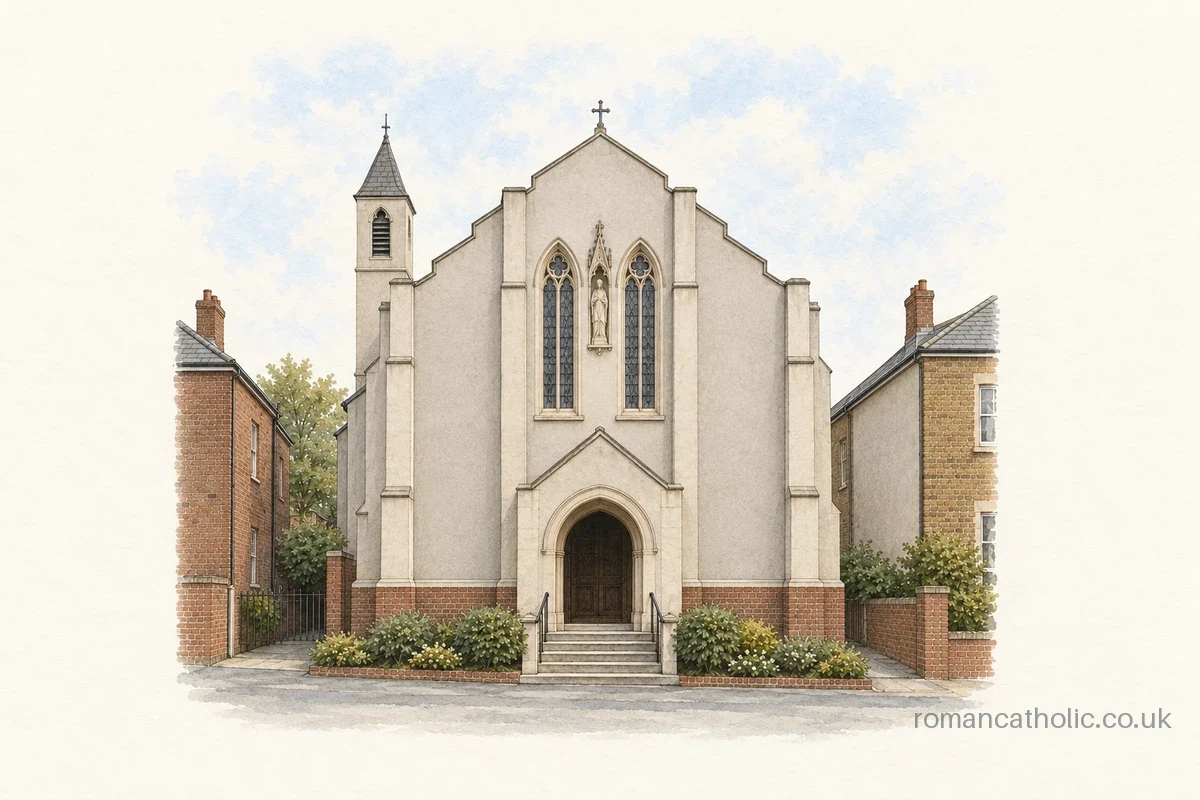
St Anthony of Padua is a Roman Catholic late Gothic Revival church of 1925-27, situated in Genoa Road, Anerley, South East London.
History
The Catholic mission in Anerley began after Canon Bethell launched a fundraising appeal which raised £407, allowing a small iron church to be built on Genoa Road on land he owned; this first church opened on 25 October 1878. In 1912 Canon Bethell died, and the following year the presbytery and site for the future church were purchased from his heirs for £700. Anerley became an independent parish in 1920. When James E. Walters became parish priest in 1924, the old debts had finally been cleared and enough funds were available to begin building a permanent church, supported by a generous £3,000 gift from Miss Mary Murphy.
Architect Frederick A. Walters, the parish priest’s father, drew up the plans, and construction began in November 1925 by builders Messrs James Smith & Sons of Norwood. The foundation stone was laid on 28 March 1926 by Bishop Brown, Assistant Bishop of the Diocese, and the church was officially opened on Easter Monday, 18 April 1927. The building, accommodating 400 people, cost £12,076, with the high altar alone costing £234. In 1936, Fr Bernard Wall became parish priest and later went on to become Bishop of Brentwood.
The church was consecrated on 14 June 1950. Some furnishings, such as painted stone statues of the Sacred Heart and Our Lady, and the font at the west end, were donated in time for the opening. Additional items, including the stone pulpit, benches, and organ, were added in the following years. Walters had originally proposed a full-height reredos, a three-stage west tower, and an apsidal baptistery, but these elements were not executed; instead, a smaller bell turret was built against the transept.
Architecture and furnishings
The church is constructed of brick and roughcast, with Bath stone dressings and a Cornish Green slate roof. Designed in a later 15th-century English Gothic style, the layout is longitudinal, featuring a lean-to south aisle and a north transept, with the sacristy to the east. A small bell turret, which also incorporates the boiler room chimney, stands on the west face of the north transept. The west façade has relatively restrained Gothic detailing, with a central gabled doorway, two ogee-arched windows, and a niche holding a statue of St Anthony.
The nave has four bays and a pointed arcade leading to the south aisle. A bronze memorial plaque near the northwest entrance commemorates the First World War fallen. The north side contains a built-in confessional and a small chapel beneath the organ loft, dedicated to St Anthony. The sanctuary is two bays deep with matching Seaton stone furnishings, including the high altar, forward altar, rails, and pulpit.
The original reredos features carved shields of the Passion, and the stone altar rails are decorated with pomegranates and the IHS monogram. The side chapel contains the octagonal stone font, a three-light window, and statues of the Virgin and Child, the Sacred Heart, and St Joseph. The south aisle, which has no side windows, houses a large Pietà dedicated to Constantine and Philip Tomei, whose names also appear on the war memorial. The west end of the aisle, formerly the baptistery, retains a piscina, aumbry, and a carved timber panel of the Baptism of Christ.
The church’s Stations of the Cross are a rare set by Flemish sculptor Aloys De Beule (1861–1935). The church offers daily Masses.
Visiting
The parish is a multi-ethnic community of approximately 250 parishioners. The narthex at the west end includes a repository. Entry is via the west doors, a northwest porch with ramp access, or a side door from the school. The church retains several original furnishings, and beside it still stands the earlier 1898 building that originally housed both the school and chapel.
Sources for this profile
- about - St Anthony of PaduaRetrieved 30 September 2026
Clergy
- Parochial Administrator Rev Joseph Edem
Find St. Anthony of Padua, Anerley
Map location for St. Anthony of Padua, Anerley
2 Genoa Rd., Anerley, Greater London, SE20 8ES