Mass times this week
Regular weekly timetable
Mon
- –
Tue
- –
Wed
- –
Thu
- –
Fri
- –
Sat
- –
Sun
- 8am, Holy Days 8am
Services with timing to confirm
These source labels need parish confirmation before they can be placed on a date.
Parish schedules can change on holy days of obligation.
What the parish's page says
Sun 8am, Holy Days 8am
Adoration & Devotions
Exposition of the Blessed Sacrament
by arrangement
Information sources
About Our Lady of Perpetual Succour
Our Lady of Perpetual Succour is a Roman Catholic place of worship in Gillingham, Norfolk. It is listed by the Diocese of East Anglia.
Introduction
Our Lady of Perpetual Succour in Gillingham, in the Diocese of East Anglia, was opened on Thursday, 18th August 1898. The church was founded by John George Kenyon (11 October 1843 – 28 July 1914). The church is a Grade II Listed Building.
History
John Kenyon built the church as a Chapel of Ease on his own land for Catholic families in Gillingham, many of whom worked on his estate. The architect Mr Banham designed the church.
In 1889, John George Kenyon unexpectedly inherited Gillingham Hall and the Gillingham Estate from his aunt, Mrs Eden. John Kenyon gave an initial donation of £500 and a guarantee of £100 a year to support a priest at Beccles.
In 1704, the Tasburgh family formally established the Flixton Mission. In 1791, the Catholic Relief Act made it possible for the Tasburghs to build a small chapel and presbytery in Bungay. On 3rd November 1889, the first Mass since the Reformation was celebrated in Beccles at a temporary chapel and residence acquired at 'Rookwood'. In 1894, Father Ford was appointed Abbot of Downside, and Father Meinred Fulton succeeded as Parish Priest at Beccles, which then had more than 300 parishioners.
In 1898, the church was built and dedicated. In 1998, the church celebrated its centenary.
John Kenyon bought a house in Grange Road, Beccles for Dominican nuns, which was vested in Our Lady of Perpetual Succour, Gillingham. Ernest Arthur Bramley invested the money from the sale of the original convent in Charibonds for the benefit of OLPS Gillingham.
Architecture and furnishings
The church contains a copy of an icon first placed in the Church of San Matteo in Rome in 1499. In 1866, Pope Pius IX ordered that the icon be given to the Redemptorist order at the Church of Saint Alphonsus in Rome.
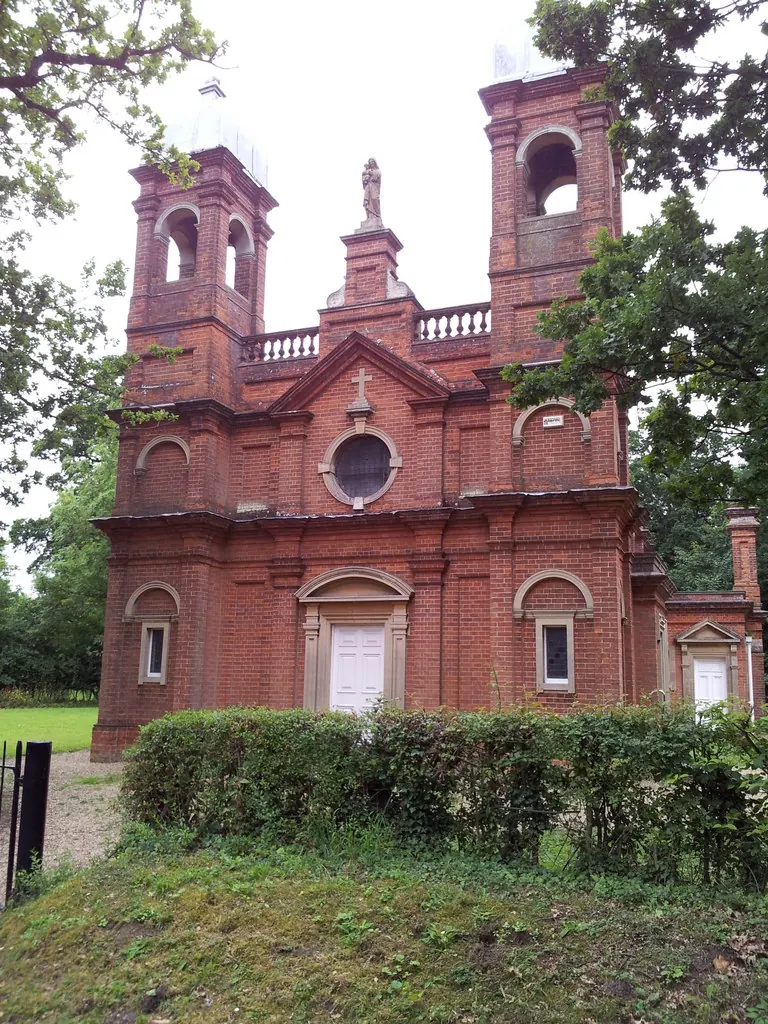
The church's unusual shape with two symmetrical belltowers is thought to be modelled on Santissima Trinità dei Monti, which John George Kenyon could see from his prison cell in Rome. The interior was originally painted to resemble many colours of marble in trompe l'oeil, but after Mrs Kenyon died in 1937, her daughter Anne Todhunter had it covered with simple white paint. The altar still faces away from the congregation and was never modified in the 1960s following Vatican II. The church has 80 hassocks, each individually embroidered in memory of a different parishioner, living or dead.
The brass Sanctuary Lamp, decorated with small angels, hangs to the left of the altar. The church takes its name from a famous icon from 1499, a copy of which is to the right of the altar.
Music and liturgy
Mass is generally celebrated without music, except on Easter Sunday and Christmas Day when an unaccompanied hymn or carol may be sung. Latin Mass is celebrated by arrangement.
The church is occasionally visited by The Latin Mass Society of England and Wales. The church has a small pedal-powered organ that is very seldom played. The church also has an electric keyboard.
Parish life
In 2007, the 350th anniversary of the start of the Benedictine Mission in the Waveney Valley was celebrated with a large outdoor Mass at Bungay on 8th July. Burials at the church are by permission of the Trustees only. Each grave may be surmounted by a single iron cross of an approved design, placed at the feet of the deceased, in line with Benedictine practice.
The church is a Chapel of Ease to St Benet’s R.C. Church in Beccles, which stands next door to St Benet’s Catholic Primary School. The church is served by the Benedictine Community of Downside Abbey.
Regular events
The church's crib is displayed every Christmas until the octave of the Epiphany. Stations of the Cross are held by arrangement. The Rosary is prayed by arrangement. Exposition of the Blessed Sacrament is held by arrangement.
Sacraments and pastoral care
Baptisms at the church are made possible at the discretion of the Trustees. The church has no permanent font, but a font can be provided for baptisms.
The church is a Chapel of Ease and therefore not licensed for civil weddings. Church weddings and blessings can be made possible by special arrangement.
Trustees may consider other requests for burial in special circumstances, such as a close family connection with the church. Interment of ashes in a grave plot is possible by arrangement with the Trustees. Once burial permission is granted, the Parish Priest is contacted to arrange the funeral ceremony. Mourners are encouraged to plant bulbs on graves; artificial flowers are not permitted.
Undertakers must be instructed to flatten the grave within one year of burial to facilitate grass cutting. For interments of ashes, one cross may hold multiple plaques to commemorate the individuals interred. The church has a collection of funeral readings that may be useful when preparing a funeral service. The church provides a sample requiem mass with example hymns and readings that can be freely adapted.
Notable people and events
John George Kenyon converted to Catholicism on 24th May 1870, influenced by Cardinal Newman. John George Kenyon was a Papal Chamberlain. The church was painted twice by Aidan Kirkpatrick (1932-2014), a noted local artist and parishioner.
Visiting
The church is kept locked outside Mass times, but visits can be arranged by contacting the Trustees. Plenty of parking is available along Church Road, just outside the church. A mobile ramp is available by arrangement for wheelchair users. The roof is lead-free: the lead was stolen in the 1970s and replaced with fibreglass.
Sources for this profile
- History – Our Lady Of Perpetual Succour, GillinghamRetrieved 30 September 2026
- Exterior – Our Lady Of Perpetual Succour, GillinghamRetrieved 9 October 2026
- Founder – Our Lady Of Perpetual Succour, GillinghamRetrieved 9 October 2026
- Icon – Our Lady Of Perpetual Succour, GillinghamRetrieved 9 October 2026
- Burials – Our Lady Of Perpetual Succour, GillinghamRetrieved 9 October 2026
- Art & Architecture – Our Lady Of Perpetual Succour, GillinghamRetrieved 9 October 2026
- Interior – Our Lady Of Perpetual Succour, GillinghamRetrieved 9 October 2026
- Our Lady Of Perpetual Succour, Gillingham – A privately-owned Roman Catholic Chapel of Ease near Beccles, SuffolkRetrieved 9 October 2026
- Links – Our Lady Of Perpetual Succour, GillinghamRetrieved 30 September 2026
- Christmas – Our Lady Of Perpetual Succour, GillinghamRetrieved 9 October 2026
- Baptisms – Our Lady Of Perpetual Succour, GillinghamRetrieved 9 October 2026
- Marriages – Our Lady Of Perpetual Succour, GillinghamRetrieved 9 October 2026
- Visit – Our Lady Of Perpetual Succour, GillinghamRetrieved 30 September 2026
- Ecological Policy – Our Lady Of Perpetual Succour, GillinghamRetrieved 9 October 2026
Find Our Lady of Perpetual Succour
Map location for Our Lady of Perpetual Succour
Norwich Rd, Gillingham, Norfolk, Gillingham, Norfolk, NR34 0AE