Mass times this week
Regular weekly timetable
Mon
- 12:30
- 18:00
Tue
- 12:30
- 18:00
Wed
- 12:30
- 18:00
Thu
- 12:30
- 18:00
Fri
- 12:30
- 18:00
Sat
- 10:00
- 18:00 Vigil
Sun
- 08:00
- 09:00
- 10:30 (Solemn Latin with choir)
- 12:00
- 16:00
- 19:00
Services with timing to confirm
These source labels need parish confirmation before they can be placed on a date.
Watch Mass online from Saint James, Spanish Place
Live at advertised Mass times
Open stream →The stream may be off-air outside the church's advertised Mass times.
See Mass times at the 345 other churches in London →
Parish schedules can change on holy days of obligation.
What the parish's page says
Time of Masses Weekdays: 12.30pm & 6pm (church open from 8.00am) Saturdays: 10am (church open from 9.00am) 6pm - Vigil Mass of Sunday Sundays: (church open from 7.30am) 8am, 9am , 10.30am (Solemn Latin with choir), Midday, 4pm & 7pm
Confession Times
- Weekdays, 12 noon–1pm
- Saturday
- 4.45–5.30pm
Adoration & Devotions
October Rosary
Each weekday evening after the 18:00 Mass, throughout October
Opening Times & Private Prayer
Weekday church open from 08:00
Saturday church open from 09:00
Sunday church open from 07:30
Languages & Rites
Solemn Latin Mass
Sundays 10:30 with choir
About Saint James, Spanish Place
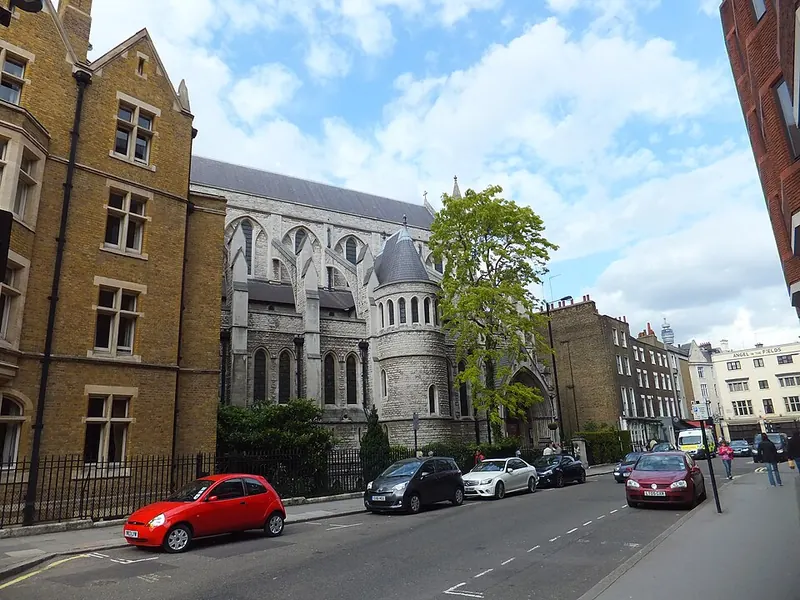
Saint James, Spanish Place is a Roman Catholic church in London, Greater London. It is part of the Archdiocese of Westminster.
Introduction
Saint James, Spanish Place, in London, was consecrated on 28th July 1949 by Bishop Craven, who was then parish priest and rector. The church is the successor of chapels attached to the Spanish Embassy in London.
History
In 1791 a chapel was built on the corner of Spanish Place and Charles Street largely through the efforts of Doctor Thomas Hussey, chaplain at the embassy since 1769. Edward Goldie, great grandson of the architect of the old chapel, Signor Joseph Bonomi, won the competition for the new church design. The consecration had been planned on two previous occasions but postponed – in 1935 because of the death of Cardinal Bourne, and in 1940 because of the second World War. Baptismal and Marriage Registers dating back to 1732 are preserved in the Church. Couples seeking marriage are asked to contact the Parish Office at least six months before their preferred date.
Architecture and furnishings
The church entrance in George Street is a copy of the main entrance to Lichfield Cathedral. The church is built entirely of stone with a purity of line that confers a true sense of majesty. The apse is heptagonal and has in its lower half seven pointed arches filled with opus sectile. The church is orientated contrary to usual church building practice.
The church is 195 ft long, 92 ft wide, 67 ft high, with seating for 800. The reredos and hanging baldacchino are by Garner.
The statue of Our Lady, Queen of Heaven, known as the Golden Lady, was made locally by a stonemason in 1840 and is reputed to be the second statue erected in a London church after the Reformation. The organ, built in 1922 by Alfred Hunter and Sons of Clapham, London, is regarded as the finest example of his craftsmanship. The Rose Window, dated 1915, portrays St James surrounded by the heraldry of the Spanish Royal Family and of the chief Bishop’s Sees of Spain. The statue of Our Lady of Fatima was presented to the church by the wife of the Portuguese Ambassador, the Duchess of Palmella, in 1949.
A fifteenth-century Florentine plaque of Our Lady was presented to the church by Dame Una Pope-Hennessy in 1942. The Cardinal Manning memorial window was commissioned under the directive of John Francis Bentley in 1896. Geoffrey Webb designed windows and furnishings for the west end, including the Baptistery and the War Memorial Chapel, once St James Spanish Place was completed in 1918.
The pulpit, made of white marble and alabaster, is ornamented by statues of St John the Baptist and St Paul. The communion rail decoration contains clusters of grapes and verses from the hymn ‘Verbum supernum prodiens’ by St Thomas Aquinas. The Martyrs’ Altar, originally the altar of St Michael, now honors fourteen of the English Martyrs canonized in 1970. The statue of St James, Patron of the Church, was restored in 2021.
The chancel reredos is made of black hammered iron decorated with gilt scallop shells and flowers. The sanctuary floor is golden mosaic. The church has a corona of rock crystals which is lowered over the monstrance during Benediction and Exposition of the Blessed Sacrament.
Alfonso XIII’s personal standard is in a frame over the sacristy door. The church has a statue of St Anne bearing the Virgin Mother and Child, a fifteenth century German wooden statue.
Edward Goldie designed this church, built 1885-90 of Kentish rag with ashlar dressings and a stone vaulted interior. The plan comprises a nave, aisles, narrow outer aisles, non-projecting transepts, an apsidal chancel, and a north Lady chapel. The design is an ambitious and highly serious Early English composition. Inside, a lofty stone interior has an eight-bay arcade with shafted piers, a full gallery bridged across the transepts, and quadripartite stone vaulting.
The nave arches are supported by pillars enriched with marble colonettes. The centre panel of the apse portrays the descent of the Holy Spirit upon Our Lady and the Apostles, while the other six contain Old Testament symbols of sacrificial and sacramental aspects of the Holy Eucharist. High on the wall above the choir stalls are two built-in gilt crowns, beneath which places were always given to King Alfonso and Queen Ena of Spain when they attended the church. In the canopied niches at the ends are gilt bronze statues of St James on one side and St Anne on the other.
Around the walls of this chapel are the fourteen Stations of the Cross carved in alabaster by Geoffrey Webb. The three stained glass windows in the chapel depict Our Lady, Star of the Sea, commemorating the men of the Royal Navy; St Michael for the men of the Royal Flying Corps; and St George for the army. The altar is a fine example of carved marble and alabaster with five panels depicting the Madonna and Child with angels in the opus sectile of the reredos.
Music and liturgy
Five ranks of pipes were retained from the Gray and Davidson organ (previously by the famous eighteenth century builder, Samuel Green) originally in the Spanish Chapel. The present organ has fifty three ranks of pipes on three manuals and pedals. The organ's wind pressures are from three and a half inches for flue-work to ten inches for the heavy reeds.
Visiting
The church has a chapel opposite the main entrance enclosed by a wrought iron screen decorated with oak leaves and fleur-de-lys, with the inscription 'Surrexit Christus spes mea' over the gate. The church has a reredos of the Sacred Heart altar depicting the Sacred Heart of Jesus together with scenes of the birth of Christ, Peter's denial, the Last Supper and Christ appearing to the doubting Thomas.
Sources for this profile
- Parish History | St. James Spanish PlaceRetrieved 8 October 2026
- Embassy Chapel | St. James Spanish PlaceRetrieved 8 October 2026
- History & Art | St James's Spanish Place | EnglandRetrieved 8 October 2026
- Church Tour | St. James Spanish PlaceRetrieved 8 October 2026
- Roman Catholic Church of St James (Spanish Place) , Non Civil Parish - 1066777 | Historic EnglandRetrieved 8 October 2026 Source text © Historic England, licensed under Open Government Licence v3.0. Summarised by RomanCatholic.co.uk.
- Parish History | St. James Spanish PlaceRetrieved 8 October 2026
- Catechetics | St James's Spanish Place | EnglandRetrieved 8 October 2026
Clergy
- Parish Priest Rev Monsignor Philip Whitmore
- Assistant Priests Rev Domenico Lando
- Assistant Priests Rev John Njorteah
Find Saint James, Spanish Place
Map location for Saint James, Spanish Place
22 George St. Spanish Place, London, Greater London, W1U 3QY