Mass times this week
Regular weekly timetable
Mon
- 09:00
Tue
- 09:00
Wed
- 09:00
Thu
- 09:00
Fri
- 09:00
Sat
- 09:00
- 18:00 Vigil
Sun
- 08:00
- 10:45
Services with timing to confirm
These source labels need parish confirmation before they can be placed on a date.
Parish schedules can change on holy days of obligation.
What the parish's page says
Mass Saturday – vigil 6:00 pm Sunday – 8:00 am & 10.45 am Daily Mass – Monday, Tuesday, Wednesday, Thursday, Friday and Saturday 9.00 am First Saturday of each month Mass at 9:00 am followed by Adoration/Benediction
About St Anthony of Padua
St Anthony of Padua is a Roman Catholic church in Rye, East Sussex. It is part of the Diocese of Arundel and Brighton.
Introduction
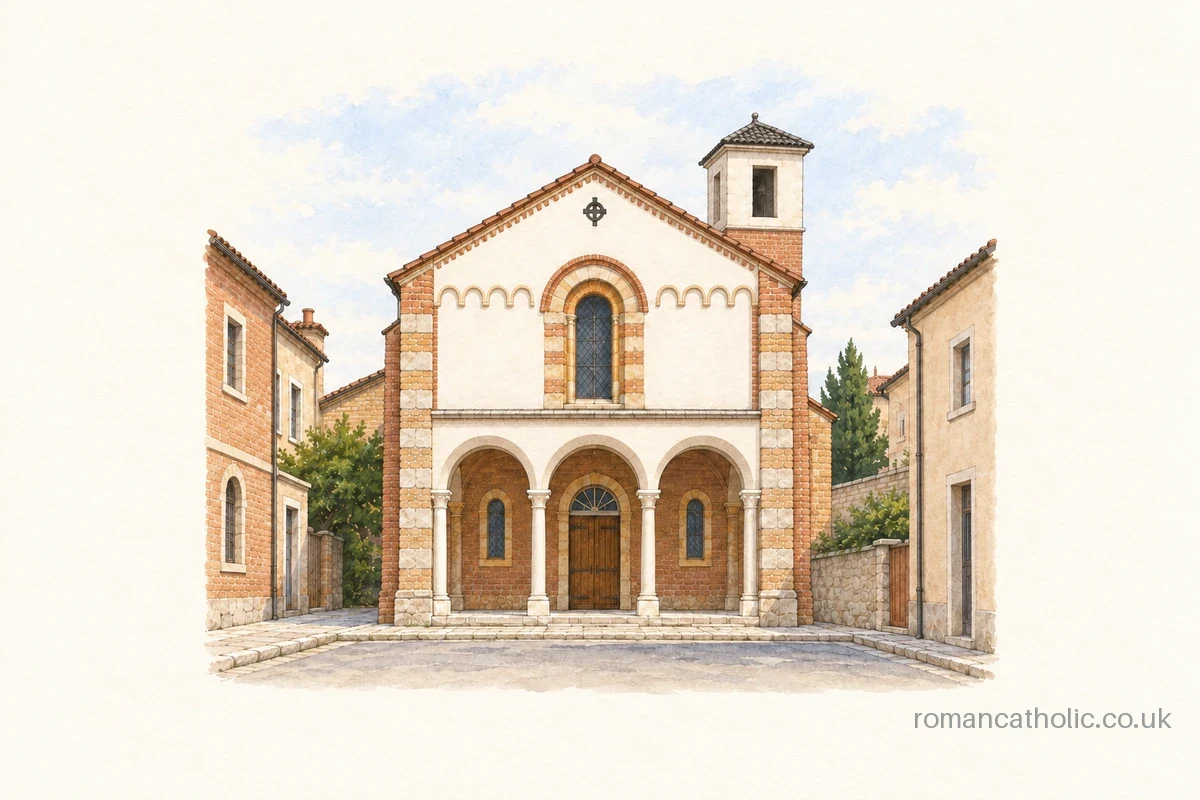
St Anthony of Padua in Rye was designed by JB Mendham for the Franciscan Order of Friars and built in 1927-9 in a Romanesque manner. The church was opened on 30th June 1929. The church is unusual in having the appearance of a small Italian or Lombardic romanesque church.
History
The church was built to replace the church of St Walburga, which had been built in 1900 when the Roman Catholic parish was restored. Early in the twentieth century, Fr Bonaventure Scebberas OFM Conv arrived from Malta to restore the Franciscan community in Britain, first by working in Rye in 1906. By 1910 the parish church had passed into the care of the Franciscans and by 1926 was too small for both the congregation and the friars. The dedication to the church changed when the new church was built, as St Walburga was not associated with the Franciscan Order.
John Bernard Mendham (1888-1951) was born in St Leonards on Sea but was brought up in Buenos Aires where his father worked as an engineer and where he became familiar with Spanish colonial architecture. The foundation stone is inscribed 'AMDG Oct 11th 1927'.
The architect John Bernard Mendham ARIBA was later associated with the design of the post-war Coventry Cathedral. A church, St Walburga, built in 1900, stood on the site of the present St Anthony of Padua.
Architecture and furnishings
The church is constructed in the Spanish-Romanesque style, with its small aisles flanked by delicate Roman columns sitting off the nave, at the head of which is the priceless marble altar. The interior has a five-bay nave with columns rather than piers, with aisles and clerestory and an apsed sanctuary. The capitals have Tau crosses in circles and Greek crosses in lozenges. The sanctuary is richly fitted out with marble steps, altar and altar rail.
The tabernacle rises to a small baldachino. Stained glass in the sanctuary, north and south, is signed Jones & Willis and may be from the earlier church. The rood cross was the gift of the author Radclyffe Hall.
The richly coloured stained glass windows on either side of the sanctuary recall holy people famous in English and Franciscan history. The spacious pulpit, the high alters and the rails are of solid Pavonazo marble, with decorative insertions with Swedish green and Italian yellow.
The altar rails, altar and pulpit are of veined marble, the altar enhanced by flush panels of deep red marble. The font is a hemispherical bowl set on enriched pink marble shafts. Stained glass includes two windows of St Anthony and St Michael which were brought from the previous church. Triple sanctuary windows are dedicated to English martyrs and Franciscan saints.
At the west end is a war memorial in the form of a Calvary. The nave is lined in Stations of the Cross. At the eastern end of the aisles are side chapels, to the south a Lady Chapel and to the north dedicated to St Anthony. Over the sanctuary is an octagonal dome, lined horizontally in timber, supported on a smooth-sided octagonal drum with a small round arched window on each face.
Behind the altar which is detached and set forward on a plinth is an ornate aedicular canopy on twisted shafts, and in front of it the tabernacle which has beaten gilded doors. The altar rails have brass gates with filigree panels. At the west end is a timber choir and organ gallery over a pair of doors leading to a porch which has pointed arched doorways to north and south and a small niche. The entrance is set behind a three-bay loggia supported on stone shafts with enriched cushion capitals.
To the south is a tall campanile, square on plan and also in brick, with a rendered bell stage with brick-lined openings with tile keys. The east end has a hemispherical copper clad apse, and below it are flat roofed vestries which have replaced windows. The church closely emulates Byzantine and early Christian Romanesque models. Attached to the church is a two storey friary house also by Mendham, which is excluded from the listing but is historically associated with the church.
The church is built of brown brick with a smooth rendered entrance front and rear, stone and tile dressings, pantiled roofs and a copper-clad apse roof. The plan comprises a five-bay aisled nave entered under a three-bay loggia, with a tall campanile to the south, an octagonal tower over the chancel, and an apsidal sanctuary with narrow north and south bays in the form of a Greek cross. The nave roof has arch-braced trusses with a plain king post and struts and cusped principal rafters supported on slender wall posts resting on stone corbels, and exposed square cut purlins over horizontal boarding. The east view has a half-dome, rising to a square and then an octagon with pyramid roof.
Sources for this profile
- RC Church of St Anthony of Padua, Rye - 1393687 | Historic EnglandRetrieved 8 October 2026 Source text © Historic England, licensed under Open Government Licence v3.0. Summarised by RomanCatholic.co.uk.
- About – St Anthony of Padua Catholic ChurchRetrieved 6 September 2026
- The Church – St Anthony of Padua Catholic ChurchRetrieved 6 September 2026
Find St Anthony of Padua
Map location for St Anthony of Padua
Watchbell Street, Rye, East Sussex, TN31 7HB