Mass times this week
Regular weekly timetable
Mon
- –
Tue
- 10:00 (homepage lists this; Mass Times page omits it; check parish)
Wed
- –
Thu
- 10:00
Fri
- –
Sat
- 17:00 Vigil
Sun
- 11:00
Services with timing to confirm
These source labels need parish confirmation before they can be placed on a date.
Stream link for St. Edward
Stream details being checked
Check stream →Please check the church name and service time on the stream page before watching.
Parish schedules can change on holy days of obligation.
What the parish's page says
Masses at St Edward’s Weekday Masses St Edward's, Clifford - 10am Tuesday and Thursday St Joseph's, Tadcaster - 10am Wednesday and Friday Weekend Masses St Edward's, Clifford - 5pm Vigil Mass (Saturday) 11am Sunday Mass
Another source gives different times for this church and we have not been able to settle which is current. Please check with the parish.
Holy Mass is offered at the following times: During the week... Mass is held on a Thursday at 10am At the weekend... 5:00pm Saturday Vigil of Sunday 11:00am Sunday Mass
About St. Edward
St. Edward is a Roman Catholic church in Clifford, West Yorkshire. It is part of the Diocese of Leeds.
Introduction
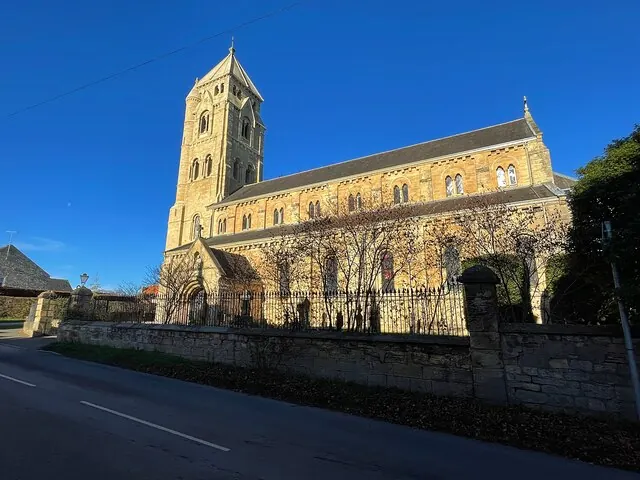
Saint Edward's Church in Clifford, within the Diocese of Leeds, was opened in 1848 before the re-establishment of Roman Catholic dioceses in 1850. The church is a bold Romanesque church in French-Norman style. The church contains the remains of the child martyr St Domitia the Second, brought over from the Catacombs of Rome.
History
In 1831 brothers Robert and Thomas Grimston settled in Clifford and opened a flax mill, employing Catholics. In 1838 Ralph Grimston and his wife Elizabeth joined the brothers in Clifford; Elizabeth held classes in religious instruction, prompting the purchase of the Wesleyan chapel and its conversion into a Roman Catholic mission church. By 1843 the congregation had swelled to 200, prompting the decision to build a larger church. The church's foundation stone was laid on 13 October 1845, the feast day of St Edward the Confessor.
During construction the remains of St Domitia the Second were transferred from Hazelwood Castle to be placed below the main altar. The church's opening on 24 May 1848 was attended by Nicholas Wiseman, who became the first Cardinal Archbishop of Westminster in 1850. Wiseman returned, along with four other bishops, on 24 May 1859 for the church’s consecration. Work building the church tower started in 1859 but was suspended until 1866 when construction was restarted to a new design by George Goldie, paid for by Ralph Grimston.
In 1998-1999 a sympathetically designed extension, appearing externally as something akin to a chapterhouse, was added to the east of the sacristy to form a set of parish rooms. The church was largely funded by the Grimston family, but also received support from the King and Queen of Sardinia and the Grand Duke of Parma.
Architecture and furnishings
The church was built 1845-1848 by JA Hansom from drawings by Ramsey, with a tower added 1866-1867 by G Goldie. The church has an eight-bay nave with side aisles, a tower projecting from the west end and a Lady Chapel projecting from the east end. The west door into the nave is a 2018 insertion completing the original design intention. The tower's fifth stage is a belvedere that provides a viewpoint for the surrounding countryside including Clifford Moor.
The east end has a recessed wheel-window flanked by a pair of oval-shaped (vesica) windows and a finial adapted from an Iona cross above. The south porch entrance is set within a three-order round arch supported by colonnettes with leaf capitals, shafts of red sandstone and a hoodmould with carved label stops in the form of leaves. The interior has pale stone ashlar walling and stone flooring with exposed dark-stained timber roof structures. The sanctuary is overlooked by three painted and gilded shield-bearing angels to each side, individually carved from the shield bosses forming the springing-points of the hoodmoulds above the nave arcades.
The east end has a triptych of arches giving a view through to the Lady Chapel, with a large timber crucifix above flanked by statues of the Virgin Mary and St John the Apostle. The Lady Chapel has a very ornately carved archway through to the semi-domed apse which holds a stone altar supported by a pair of kneeling angels carved in full relief. The south side chapel is stone vaulted and separated from the south aisle by a low wall and gates, with an ornamented stone altar supporting a stone reredos incorporating a tabernacle for the Blessed Sacrament.
The crypt is a small barrel-vaulted chamber below the side chapel lit via a small window in the east wall and containing two sarcophagi, with individual burial vaults in the west wall. The church has 26 stained glass windows of varying dates (1848-1986), styles and qualities, mostly Victorian. Two stained glass windows (both 1848) are by AWN Pugin, in the north aisle bays two and four from the east. Five stained glass windows are by A Lusson or Lusson and Bourdon of France, dated to the 1850s, in the north aisle bay one and the windows to the side chapel.
The church contains a Carrara marble sculpture of the Virgin Mary by Karl Hoffmann, carved in Rome in 1844. Hoffmann is said to have converted from Judaism to Catholicism during his creation of the statue. The tower, by George Goldie, combines the functions of an open porch, organ chamber, bell tower and viewing platform. The design of the tower incorporates a belvedere from which Clifford Moor can be seen, the final mustering point of the 1569 Northern Rebellion.
The church is built of stone ashlar, mainly magnesium limestone with sandstone for the plinth, and has a green slate roof laid to diminishing courses. The west tower has five stages capped by a pyramidal stone ashlar roof with ribs and apex finial surmounted by a cross. The tower's second stage forms an organ chamber internally, open to the gallery at the west end of the nave.
Visiting
The church provides a live stream for Mass and other occasions, accessible via a link with a password. The bottom stage of the tower is cross-vaulted, open on three sides with large porte-cochère-style openings. The church has an enclosed porch projecting from the sixth bay of the south aisle. Above the entrance is a round-arched niche containing a weathered statue of St Edward the Confessor flanked by colonnettes.
The westernmost bay of the nave is divided off by a screen of three arches to form a narthex for the west door, with the arches infilled with modern plate glass screening. Above the narthex is a choir gallery with an archway through to an organ chamber housed in the second stage of the tower.
Sources for this profile
- Roman Catholic Church of St Edward, King and Confessor, Clifford - 1313483 | Historic EnglandRetrieved 8 October 2026 Source text © Historic England, licensed under Open Government Licence v3.0. Summarised by RomanCatholic.co.uk.
- St Edward's Catholic Church Clifford - HomeRetrieved 8 October 2026
Find St. Edward
Map location for St. Edward
Chapel Lane, Clifford, West Yorkshire, LS23 6HU