Mass times this week
Regular weekly timetable
Mon
- 10:00
Tue
- –
Wed
- –
Thu
- 10:00
Fri
- –
Sat
- 12:00
Sun
- 09:15
Services with timing to confirm
These source labels need parish confirmation before they can be placed on a date.
See Mass times at the other church in Rochdale →
Parish schedules can change on holy days of obligation.
What the parish's page says
St John the Baptist ... Location: Dowling Street, Rochdale OL11 1EX Sunday Mass: 9.15am Weekdays: Mon, Thu 10am, Sat 12noon
Opening Times & Private Prayer
Wednesday 10:00-14:00 (guided tours, open to all, no booking required)
Information sources
About St. John the Baptist, Rochdale
St. John the Baptist, Rochdale is a Roman Catholic church in Rochdale, Greater Manchester. It is part of the Diocese of Salford.
Introduction
Bishop Casartelli laid the foundation stone on 28 July 1923. Plans were prepared before World War One when the cost including a campanile (not built) was an estimated £12,800. The current building replaced an earlier 1830s stone church, also named St John's.
Architecture and furnishings
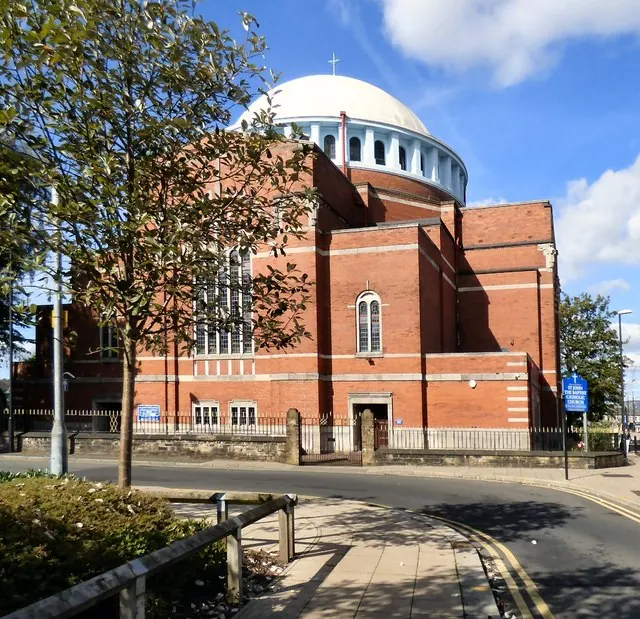
The church has a ferro-concrete dome and barrel vaults, red brick with artificial stone dressings, in Early Christian Byzantine style. The church has a cruciform plan with central dome, narthex, vaulted transepts, apsidal sanctuary and sacristy. The exterior walls are faced in brick in English garden wall bond (3:1). The liturgical west elevation faces Dowling Street and has a deep artificial stone plinth and a tall central gable.
The liturgical south elevation faces Maclure Road and has a tall central gable with a five-light window in a semi-circular arched recess. The church is built in the style of a Greek cross with the four transepts forming the arms. The concrete dome and barrel vaults are one single slab of concrete, only five inches thick at the dome and 95 feet high. In the 1990s a community room and kitchen were built in the north transept, and parish accommodation, a piety shop and a sacristy in the south transept.
The apsed sanctuary is completely covered in a mosaic scheme with the theme Eternal Life designed by Eric Newton. Newton started the mosaic scheme in 1932 and took over a year to complete it at a cost of £4,000. The mosaic depicts Christ the King with angels and twelve sheep at his feet representing the Apostles, offset by a gold background. The mosaic includes panels showing St John baptising Christ and awaiting his own beheading.
Furnishings brought from the C19 church include a font of 1830 by Lupton and the altar and pulpit of 1898 by Alberti. The interior includes curved walls linking transepts to sanctuary with round-headed openings, chapels, confessionals and balconies with curved iron balustrades.
The altar, pulpit, organ, baptismal font, altar rails and pews were transferred from the old church. The pulpit was later removed and remodelled to construct the lectern, the organ was replaced by an electric organ, and the font was moved to the front. The mosaic covers an area of over 315 square metres and includes an unusual depiction of the devil inspired by William Blake. The mosaic's high-quality tiles were sourced from Venice and other glass and tesserae from artisans in France.
Music and liturgy
Following the Second Vatican Council, the altar rail was removed, a new altar was placed near the front of the sanctuary so the priest could face the people, and Mass began to be celebrated in English rather than Latin. A choir gallery over the narthex, reached by stairs in the liturgical north-west corner, provides space for the choir.
Parish life
The community garden project has achieved RHS awards for planters made from sustainable recycled materials. The St Gabriel’s and St John’s SVP Conference is a small unit of volunteers within the parish offering financial, emotional and practical support to individuals and families. In October 2017, the parish established a leadership management structure to support the work of integrating the two churches. The parish has six active groups: Liturgy, Pastoral, Youth, Building and Maintenance, Finance, and Social and Communication, with chairs forming the Parish Leadership team. The parish has many refugees and asylum seekers, and as a parish tries to help them when they first arrive, which is a big part of the parish apostolate.
Regular events
Heritage tours and open days are held to welcome visitors. An annual Mass is celebrated for the elderly, sick, and housebound, with transport and refreshments provided. Planned activities include mosaic classes and concerts.
Sacraments and pastoral care
Eucharistic Ministers regularly bring the Eucharist to about fifty elderly, sick and housebound parishioners of both churches in their homes or residential units. Fifty-two elderly, sick or housebound parishioners received a small gift and a card to show they were remembered, and a Mass was celebrated for them.
Visiting
Visitors can tour the church with knowledgeable and enthusiastic guides and view regular temporary exhibitions featuring the outcomes of activity themes, such as heritage photography. A variety of activities are offered at different points during the year, including family arts and crafts sessions. Group visits can be booked so a guide is available to take the group around. There is disabled access to almost all areas of the church.
A 3D church tour is available on the media page. The church is a Grade II* listed building that visitors are welcome to step inside. The church draws in visitors of differing faiths and those of no faith. The church is situated at the transport gateway to the town.
The church was built to host up to 1200 people. The church has a dome that can be seen for miles around. The interior of St John’s is characterised by long curved lines and unadorned smooth walls, with opulent Oppenheimer mosaics in the sanctuary.
The mosaic was cleaned and restored by a team of heritage specialists from Gary Bricknell’s Mosaic Restoration Company. The church is a Grade II* listed building due to its artistic interest – the Oppenheimer mosaic – and its architectural interest – the Byzantine style with a large dome in the manner of Hagia Sophia. The church is open for private prayer and reflection, and to provide the opportunity to learn about the heritage of the building and its people.
Sources for this profile
- Heritage - St John the Baptist Church - RochdaleRetrieved 30 September 2026
- Roman Catholic Church of St John the Baptist, Non Civil Parish - 1376506 | Historic EnglandRetrieved 8 October 2026 Source text © Historic England, licensed under Open Government Licence v3.0. Summarised by RomanCatholic.co.uk.
- Community Garden - St John the Baptist Church - RochdaleRetrieved 8 October 2026
- Parish - St John the Baptist Church - RochdaleRetrieved 8 October 2026
- Significant individuals - St John the Baptist Church - RochdaleRetrieved 8 October 2026
- Home - St John the Baptist Church - RochdaleRetrieved 30 September 2026
- Visiting - St John the Baptist Church - RochdaleRetrieved 30 September 2026
- 3D Mosaic Tour - St John the Baptist Church - RochdaleRetrieved 8 October 2026
Find St. John the Baptist, Rochdale
Map location for St. John the Baptist, Rochdale
1 Dowling St., Rochdale, Greater Manchester, OL11 1EX