Mass times this week
Regular weekly timetable
Mon
- 09:30
Tue
- 08:00
- 10:00
Wed
- 08:00
- 10:00
Thu
- 08:00
- 10:00
Fri
- 08:00
- 10:00
Sat
- 09:30
- 17:45 Vigil
Sun
- 09:30
- 11:00
- 18:00
Services with timing to confirm
These source labels need parish confirmation before they can be placed on a date.
Stream link for St. John the Evangelist, South Parade
Stream details being checked
Check stream →Please check the church name and service time on the stream page before watching.
See Mass times at the 4 other churches in Bath →
Parish schedules can change on holy days of obligation.
We do not hold the page these times were published on, so we cannot show you when they were last confirmed. Mass times may change; check with the parish before travelling.
Confession Times
- Saturdays
- 10am – 10.30am
- Saturdays
- 5 – 5.30pm
- Sun
- 5:50 – 6:20pm
Adoration & Devotions
Rosary
Tuesday – Friday: 6pm; Monday & Saturday: 10am
Adoration
Tuesday to Friday 10.30am to 5.30pm
Morning & Evening Prayer
Mondays & Saturdays: 9am; Tuesday – Friday: 9.30am & 5.30pm
Information sources
About St. John the Evangelist, South Parade
St. John the Evangelist, South Parade is a Roman Catholic church in Bath, Somerset. It is part of the Diocese of Clifton.
Introduction
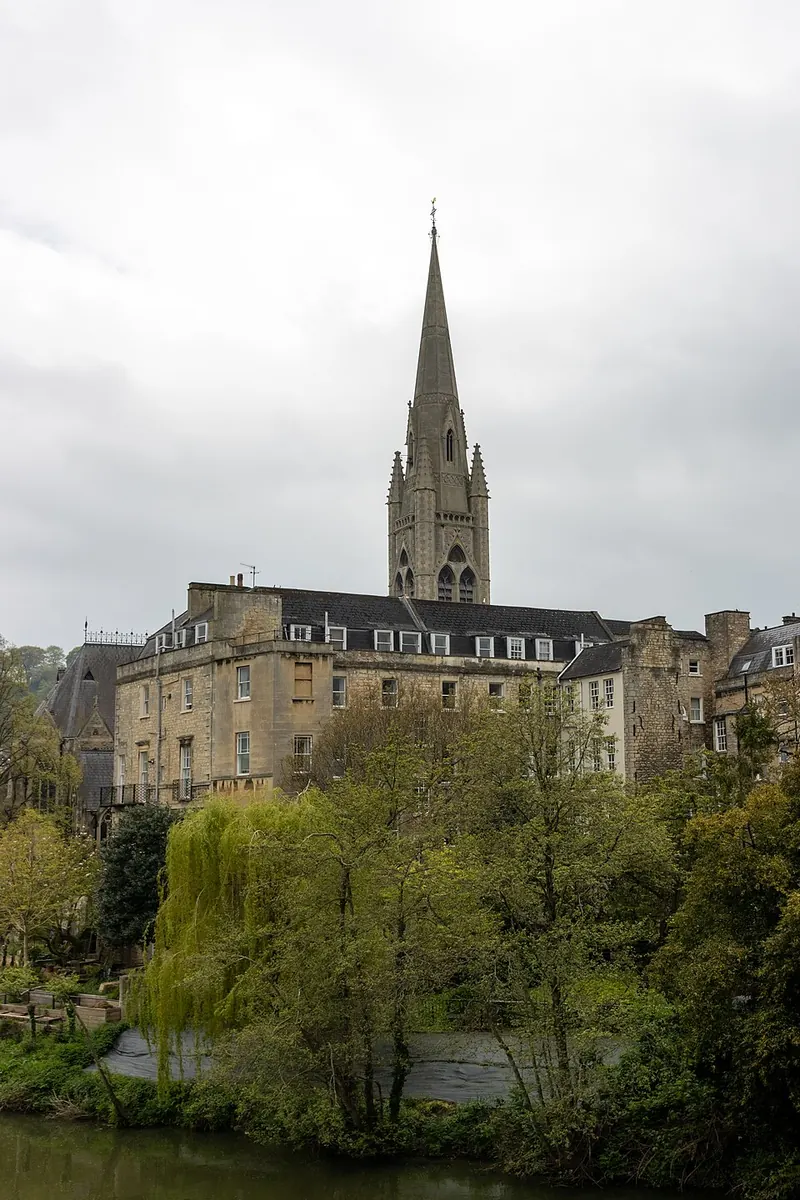
Saint John the Evangelist, South Parade, in Bath, was built 1861-1863, with tower and spire added in 1867, designed by Charles Francis Hansom. The church is a major Gothic Revival church in the Decorated style.
History
The church was founded as an off-shoot of Downside Abbey, replacing the inadequate chapel in Corn Street. The foundation stone was laid in 1861. The church was completed and consecrated in 1863.
The site was acquired from Earl Manvers. The spire, added in 1867, transformed the Bath skyline.
The spire, 202 feet high, was not finished until 1867. The tower initially finished at the arcaded parapet level.
The spire contains a bell inscribed with the words 'Long live Pius IX Pope and King'. The 9th bell is inscribed 'Long Live Pius IX, Pope and King' and is assumed to have been hung post-1878. The 3rd, 4th, 5th and 8th bells were hung between September and November 1868, and the 1st, 2nd, 6th and 7th in 1878, cast and installed by a Loughborough firm believed to be John Taylor & Co.
The church has a ring of eight bells by Taylors of Loughborough, installed in 1868 and 1878. The church has a total of 9 bells; 8 bells operated by two Ellacombe Chimes frames and an individual 9th bell operated by rope. The 1st–8th bells, in the key of F, are dedicated to various saints. Each of these bells is inscribed with the words 'Orate pro nobis' (Pray for us).
The 8th bell is the heaviest weighing 19 cwts 2qrs 24 lbs. The clock was installed in 1868. The church was not transferred to Clifton Diocese until 1932. Charles Hansom considered the church to be one of his best works.
The Baptistery contains relics of Saint Justina within a shrine designed by Edward Hansom in 1871. The church has a 3-manual organ by Walker, originally built in 1966.
Architecture and furnishings
The church has a cruciform plan with nave, aisles, transepts, polygonal apse, side chapels, west tower, and north-west porch. The church has a five bay nave arcade of polished red Devonshire marble with large foliate capitals of Ancaster stone, fourteen columns in all. The altarpiece is of polished marble and alabaster by Earl of London. Stained glass and metalwork by Hardman of Birmingham received some damage in the bombing of 1942.
The ironwork parclose screens are an important survival of the work of John Hardman Powell. The roof is supported by timber ribs, and ceilings panelled large squares with central bosses, probably post WWII repair. The fall in levels from west to east made possible the construction of a lower level of rooms at the east end beneath the sacristies. The church is built of rock-faced Bath limestone rubble with freestone dressings and Welsh slate roofs replaced in 1994.
The central arched doorway is surmounted with a relief of the eagle of Saint John within a crocketed gable. The octagonal spire, based on that of Salisbury Cathedral, was added in 1867.
The High Altar is of white marble on coloured marble columns and contains the Holy Relics of Saint Justina of Padua. The four panels of the reredos illustrate scenes from the life of Saint John the Evangelist. The Lady Chapel is in the northeast of the church, left of the sanctuary or chancel. The statues on either side of the entrance arch represent Saint Joseph and Our Lady of Lourdes.
The Lady Chapel altar stood in Bath’s Catholic church in Old Orchard Street until Saint John’s was built. Cuthbert Pugin designed Saint John’s rood screen, made by Hardman Powell & Co and unveiled in October 1905. The rood screen framework is made of 'Besteel' and the entire screen is coated with bituminous paint; the figures are said to have been made in Oberammergau. The rood screen was restored in 2017 by Dorothea Restorations Ltd of Bristol. During the pandemic, when other church music could not be performed, the bells were chimed each Sunday, receiving a very positive response.
Parish life
The parish has a Parish Forum Group that has met since early 2023 to support the parish priest in implementing a pastoral vision. The parish priest also takes care of the Catholic students from the University of Bath and Bath Spa University.
The peregrines first bred in 2006 and have successfully hatched and reared young every season since. The parish has a team of catechists who accompany people preparing for the sacraments.
The parish has a Pastoral Assistant and a parish office in the presbytery. The parish has a Patmos Choir that leads music and reflection in the days leading up to Christmas. The parish has a weekly newsletter that is sent by email.
Visiting
A visitors guide with a detailed account of all the stained glass windows is available through the parish office. The peregrine falcons nesting on the spire can be seen through a nest webcam. The Hawk and Owl Trust monitors the peregrines' progress and well-being.
Sources for this profile
- Roman Catholic Church of St John, Non Civil Parish - 1394998 | Historic EnglandRetrieved 8 October 2026 Source text © Historic England, licensed under Open Government Licence v3.0. Summarised by RomanCatholic.co.uk.
- History – St. John the EvangelistRetrieved 29 September 2026
- Organ, Bells & Clock – St. John the EvangelistRetrieved 8 October 2026
- Discover St John’s – St. John the EvangelistRetrieved 8 October 2026
- Rood Screen – St. John the EvangelistRetrieved 8 October 2026
- Who We Are – St. John the EvangelistRetrieved 6 September 2026
- Falcons – St. John the EvangelistRetrieved 8 October 2026
- First Holy Communion – St. John the EvangelistRetrieved 8 October 2026
- Parish of St John the Evangelist, Bath - Newsletter for the Third Sunday of Advent (A), 14 - 20 December 2025Retrieved 29 September 2026
- St. John the Evangelist – Catholic ChurchRetrieved 29 September 2026
Find St. John the Evangelist, South Parade
Map location for St. John the Evangelist, South Parade
South Parade, Bath, Bath, Somerset, BA2 4AF