Mass times this week
Regular weekly timetable
Mon
- 10:00
Tue
- 08:00
Wed
- 18:00
Thu
- 12:15
Fri
- 10:00
Sat
- 10:00
- 18:00 Vigil
Sun
- 09:30
- 11:00
Services with timing to confirm
These source labels need parish confirmation before they can be placed on a date.
See Mass times at the 6 other churches in Ipswich →
Parish schedules can change on holy days of obligation.
What the parish's page says
Mass: Sat 6pm; Sun 9:30am, 11am. Mon 10am; Tues 8am (TLM); Wed 6pm; Thurs 12:15pm; Fri 10am; Sat 10am. Hds: 8am (TLM) 12:15pm, 7pm
Confession Times
- 30 minutes before each Mass
- First Friday of each month 6pm - 7pm
- Saturday
- 5pm - 5:45pm
Adoration & Devotions
Rosary
After Mass, Mon – Fri
Adoration
Saturday 5pm - 5:45pm
Adoration
First Thursday of the month 11:15am - 12:15pm
Information sources
About St. Pancras
St. Pancras is a Roman Catholic church in Ipswich, Suffolk. It is part of the Diocese of East Anglia.
Introduction
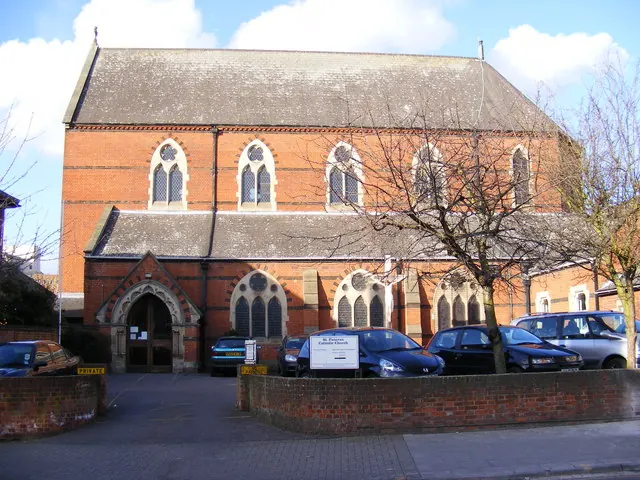
Saint Pancras is a Roman Catholic church in Ipswich, built in 1860-1861 to the designs of George Goldie. The church is listed at Grade II. The church was constructed to provide a more central place of worship for Ipswich's Roman Catholic community than St Mary's.
History
The Ipswich Journal reported that 200-300 attended the laying of the foundation stone for St Pancras in 1860. The church was opened by the Bishop on 12 June 1861, when Monsignor (later Cardinal) Henry Edward Manning preached.
Much of St Pancras's building had been financed from the estate of L'Abbe Louis Simon, a French priest who settled in Ipswich in 1793. St Pancras originally had a spire, estimated to give church a height of 120ft but this was removed after 50 years because of fears that it was becoming unstable and unsafe.
In 1899 the original scheme of decoration was changed and the walls were repainted in light terracotta with light green around the arches and the sanctuary in deep Pompeian red, green, and terracotta. The East Anglian Daily Times reported in 1910 the dedication of a new organ for St Pancras - one that had originally been built for Glemham Hall.
In 1922 a War Memorial plaque was installed made by H Grimwood working at LJ Watts of Colchester. In 1924 the Lady Chapel was redecorated by Archie Jarvis.
In June 1935 Reverend Edmund Joseph Golston was made a priest at St Pancras in the first Catholic ordination in Ipswich for 400 years. During the Second World War Polish troops stationed in Ipswich donated a painted icon of our Lady of Czestochowa to the church.
During the second world war the church was shaken by bombs aimed at the town's docks and the roof was pierced by machine-gun bullets but no substantial damage was done apart from broken windows and loosening of slates. The high altar was removed as part of a reordering following the Second Vatican Council (1962-1965) but the reredos was retained.
The East Anglian Daily Times and Evening Star reported on June 13 1961 how a telegram from the pope was read in the church as part of the celebrations of its centenary. Parts of the church were destroyed by a fire on Christmas Day in 1985.
A fire damaged the west gallery and stair in 1985 and following repair the organ was restored by Bishop and Son around 2000 and moved to the southern end of the gallery in 2021. The church was first listed on 6th April 1988.
Architecture and furnishings
The walls are of red brick with blue brick detail and ashlar dressings with slate-covered roofs. The nave and sanctuary are a single range with an apsidal east end, south and north aisles wrapping around the sides of the apse, a south porch and a single range projecting from the east end of the sanctuary on the south side. The western end of the nave has a large wheel window containing eight outer quatrefoils and a large central cinquefoil above which are a pair of lancet windows. The central window of the apse includes a window of 1860 depicting St Pancras.
The original Caen stone and marble altar is set on three arches with short marble columns, with a low reredos carved with rose, lily of the valley and marguerite surmounted by a metal tabernacle and statue of Our Lady. Beneath the gallery is the original Caen stone font with round bowl on four clustered columns with a sculptured band of water lilies and four bosses of crystal spar around the bowl. An organ by Norman and Beard was added in 1910 but originally built for Glemham Hall in Suffolk in 1891.
The church contains the Shrine of Our Lady of Poland, a souvenir of the stay in the town of the Polish Free Army during the second World War. To mark the millennium, a new west window was commissioned.
Music and liturgy
All hymns at weddings must be chosen from the parish hymn book, the Celebration Hymnal for Everyone, published by McCrimmon, 1994. At weddings, only organ music or unaccompanied singing is permitted, and recorded music is not permitted. At weddings, family members or friends of the couple may sing as cantors or form a choir for the Mass. All funeral services at St Pancras are requiem Masses.
Sources for this profile
- Church of St Pancras, Non Civil Parish - 1264101 | Historic EnglandRetrieved 8 October 2026 Source text © Historic England, licensed under Open Government Licence v3.0. Summarised by RomanCatholic.co.uk.
- Our parish - St Pancras Catholic Church IpswichRetrieved 29 September 2026
- Weddings-at-St-Pancras-Church-Ipswich.pdfRetrieved 8 October 2026
- Sacraments & Funerals - St Pancras Catholic Church IpswichRetrieved 8 October 2026
Clergy
- Pastor Fr. Joseph Welch
Find St. Pancras
Map location for St. Pancras
1 Orwell Place, Ipswich, Suffolk, IP4 1BD