Mass times this week
Regular weekly timetable
Mon
- –
Tue
- –
Wed
- –
Thu
- –
Fri
- –
Sat
- –
Sun
- 09:00
Services with timing to confirm
These source labels need parish confirmation before they can be placed on a date.
See Mass times at the 7 other churches in Lancaster →
Parish schedules can change on holy days of obligation.
What the parish's page says
Sunday - 09:00 - Thurnham
About Sts.Thomas and Elizabeth
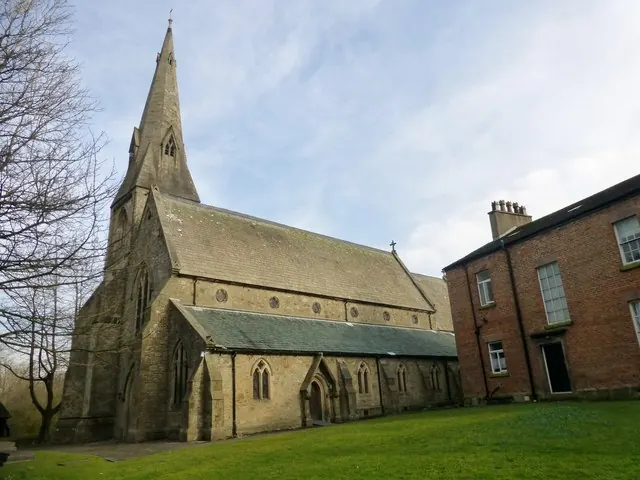
Sts.Thomas and Elizabeth is a Roman Catholic church in Lancaster, Lancashire. It is part of the Diocese of Lancaster.
Introduction
The exterior is built of stone from Miss Dalton's quarry near Lancaster. The church was built by George Taylor of Coventry, whose bill was £2,010.
History
John Dalton died on 10 March 1837 and left £200 towards the building of a new church. Father Crowe invested building funds in the Birmingham to Gloucester railway line, selling shares in 1847 to contribute £274 15s to the Building Fund. Miss Elizabeth Dalton offered to pay the balance of the costs of building a new church on the site of the chapel. The church was ready for 29 August 1848.
The church was solemnly consecrated by the Vicar Apostolic of the Lancashire District on the feast of the Beheading of St John the Baptist. The church opened with no debts, as Miss Dalton settled every account.
Architecture and furnishings
The church is of the highly decorated style of architecture, a revival of a fourteenth-century parochial church. The plan includes a nave with east and west aisles, a chancel, tower, east porch and two sacristies. The spire rises to a height of one hundred feet terminating with a brass cross. A private entrance was built for Miss Dalton, approved by the Bishop of Liverpool.
The chancel is divided from the nave by a carved stone screen with an oak rood. The high altar has sculptured panels with subjects from the Passion of Our Lord. The church has Fourteen Stations of the Cross in bas relief. The belfry contains five bells cast by John Taylor of Loughborough.
The churchyard cross base is the same stone that stood in the Monks' cemetery at Cockersand Abbey. The statues by the High Altar were made by Messrs Lane and Lewis, and the stained glass windows by Wailes of Newcastle under Lyme. Miss Gillow gave a silver monstrance designed by A W Pugin and made by J Hardman & Co, costing £70. Mr T F Brockholes presented a richly enamelled chalice from Hardmans.
Miss Dalton instructed the architect Charles Hansom, from whose designs the present church was built. The nave is divided from the aisles by circular pillars and chamfered arches, four on each side. The internal dimensions of nave and aisles are 65 feet by 38, of the chancel 25 feet by 16, with accommodation for 400 persons. The altars and other carvings are by Mr Myers of London; the decoration and gilding by Mr Souter of Birmingham; the bell chimes by Mr Meeyer of Bristol; and the brass and goldsmiths work by Mr Hardman of Birmingham.
Parish life
The Dalton family, who owned Thurnham Hall from 1556, were staunch Catholics and became immensely rich, owning quarries that employed many Lancaster people. A Building Fund was opened and had £497 14s 0d available after 5 years of interest on Miss Daniel's money. In 1817, John Dalton, Robert Gillow and Richard Worswick agreed to subscribe £50 each and defray one third each of the remaining cost for the completion of the chapel. The churchyard is entered by a lych gate of wood on a stone base, provided with a lych stone whereon to rest the coffin while waiting for the priest.
Notable people and events
Rev. Henry Holden served at Thurnham in 1675 and died there in 1688. Rev. Thomas Taylor was appointed to Thurnham and was involved in the 1715 Jacobite Rebellion. Rev. Robert Banister served from late 1774 for some 9 years.
Visiting
The tower serves as the baptistery, with the font at its centre and an aumbrey in the wall for reserving baptismal oils. The choir and organ are located at the north end of the nave, reached by a circular staircase from the porch. In the tower's second stage is the chamber with machinery for ringing the 'Angelus' at three stated times daily. On each side of the altar window are niches with carved corbels and canopies, containing statues of St Thomas the Apostle and St Elizabeth of Hungary, the church's patrons.
The sedilia on the west side consist of three deeply recessed arches with a smaller one for the sacrarium, and an opening lets the sacristan observe the chancel. A west door leads to two ample sacristies fitted with vestments, chests and presses, and a corridor connects them to the Priest's house and church. The Ladye Chapel at the south end of the east aisle is separated by a carved stone screen with a crocketted gable, surmounted by a figure of Our Blessed Lady with the Infant Jesus. The north window has three lights: St Cecilia in the centre, St George and St Michael on the sides, and below are the arms of Miss Dalton and the two Bishops of the district.
The clerestory windows are small quatrefoils filled with angels playing musical instruments, forming the heavenly choir. The aisle windows have simpler stained glass with circles containing monograms of Miss Dalton's friends and sacred emblems; the north end of the west aisle shows three figures of patron saints. The church furniture is costly: the monstrance, chalice and cruets are of gold and silver with precious stones, presented by personal friends of the foundress. A brass plate in the east aisle, with the foundress's arms supported by angels, records the founding and dedication of the church.
The opening of the church was reported in full in the national Catholic publication 'The Tablet'. The opening was a major event in re-establishing public Catholicism in the North West, being the first Catholic Church built in the Lancaster area. The procession entered by the north door and advanced up the nave. The music was chiefly from Haydn and Mozart, with 'O Salutaris Hostia' and 'O Jesu' given a thrilling effect at the Offertory and Elevation.
Sources for this profile
- History | Thurnham ChurchRetrieved 29 September 2026
Find Sts.Thomas and Elizabeth
Map location for Sts.Thomas and Elizabeth
2 Lodge Cottages, Lancaster, Lancashire, LA2 0DT