Mass times this week
Regular weekly timetable
Mon
- 08:00
- 12:10
Tue
- 08:00
- 12:10
Wed
- 08:00
- 12:10
Thu
- 08:00
- 12:10
Fri
- 08:00
- 12:10
Sat
- 10:00
- 17:30 Vigil
Sun
- 09:15
- 11:00
- 17:30
Services with timing to confirm
These source labels need parish confirmation before they can be placed on a date.
Stream link for Cathedral of St. John the Evangelist, Salford
Stream details being checked
Check stream →Please check the church name and service time on the stream page before watching.
See Mass times at the 3 other churches in Salford →
Parish schedules can change on holy days of obligation.
What the parish's page says
Holy Mass Sunday: 9.15am, 11.00am & 5.30pm Monday – Friday: 8.00am & 12.10pm Saturday: 10.00am & 5.30pm Vigil Mass
Confession Times
- Monday – Friday
- 11.30am – 11.55am
- Saturday
- 10.30am – 11.25am
- Saturday
- 4.45pm - 5.15pm
Opening Times & Private Prayer
Monday to Friday: 7.30am—4.30pm
Saturday & Sunday: 8:30am - 6.30pm
Information sources
About Cathedral of St. John the Evangelist, Salford
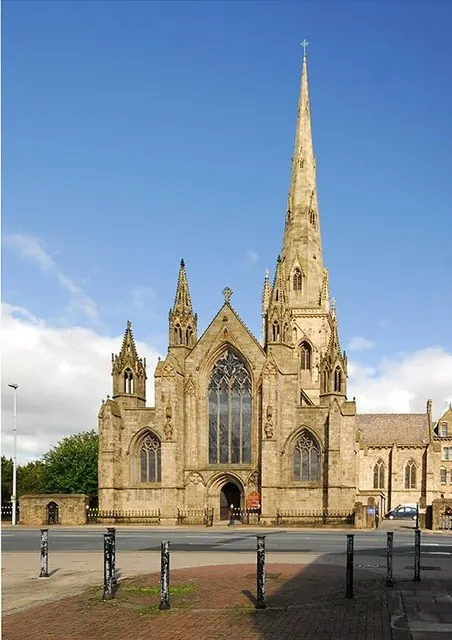
Cathedral of St. John the Evangelist, Salford is a Roman Catholic church in Salford, Greater Manchester. It is part of the Diocese of Salford.
Introduction
The Cathedral of Saint John the Evangelist in Salford, in the Diocese of Salford, was opened on 9 August 1848, designed by architect Matthew Ellison Hadfield of Weightman and Hadfield, with construction by Benjamin Hollins of Manchester. The formal opening as a cathedral took place on 27 September 1855, with Cardinal Nicholas Wiseman preaching at the inaugural Mass. The cathedral was consecrated in 1890 by Bishop Herbert Vaughan, the second Bishop of Salford, after the last £1,000 of the original debt was paid.
History
Bishop James Sharples laid the foundation stone on Whit Thursday 1844 before about 6,000 people. In 1850 the Diocese of Salford was formed and Rev. William Turner was consecrated first Bishop of Salford on 25 July 1851. In October 1881 a storm damaged the 240-foot spire; Canon Beesley raised funds for repairs and refurbishment. The Blessed Sacrament chapel in the south transept was furnished in 1884 to designs by Peter Paul Pugin, with painted decoration by Joseph Aloysius Pippet.
In 1919–20 the west front turrets were taken down and rebuilt by O’Neill & Son under Charles M. Hadfield, grandson of the original architect. The War Memorial Chapel in the north transept was opened in 1923. Post-war restoration included the mosaic floor of the choir and chancel originally by Minton. Restoration and re-ordering in 1971–72 cost £80,000 and included a new free-standing altar under the crossing.
A further re-ordering in 1988 removed the original stone High Altar and Reredos installed in 1853-55 to designs by George Goldie. A new stained-glass west window was installed in 1994 to commemorate the 150th anniversary of the foundation stone. Restoration of external stonework to the spire and west front took place in spring 2007. In November 2021 the cathedral announced its multi-million pound Restoration Project.
The cathedral closed in July 2023 for interior work, with the parish moving to a temporary church on Great George Street. The restoration project cost over £20 million, funded by diocesan reserves and a legacy from the Albert Gubay Foundation. Purcell Architects and Simpsons of York provided expertise for the restoration.
Phase 1 of the restoration began on 12 September 2022, focusing on the exterior including re-roofing and masonry repairs. In 2018 the north aisle was re-roofed with stonework repairs and new flashings, ridge tiles and gutters. The restoration included complete roof repair, masonry repair, and major spire restoration with new pinnacles.
Architecture and furnishings
The cathedral is a Grade II* Listed Building. The modern high altar, installed in the 1971-72 reordering, is of Bottichino marble; the ambo and baptismal font were added in the 1985-88 reordering. The mosaic floor, originally by Minton, was extensively restored after the Second World War, probably by Ludwig Oppenheimer Ltd. The Blessed Sacrament Chapel dates from 1884, designed by Peter Paul Pugin, with carved marble altar and reredos by Robert Lockwood Boulton.
The Great East Window was installed in 1854, paid for by Bishop William Turner and made by William Wailes of Newcastle. During the Second World War all stained glass windows were removed and stored at Leagram Hall, and the east window was restored and returned after the war. The Holy Rosary altar, installed in 1886, was moved from the south transept to the north transept in 1951. The Lee chantry chapel was established by Daniel Lee, a major benefactor, with a memorial brass by Hardman of Birmingham.
The Lady Chapel has a carved alabaster altar with reredos of painted stone with Devonshire porphyry piers, all carving by Lane and Lewis. The restoration repositioned the altar to reflect the original Latin cross design, reinstated chapel screens, created a new Chapel of Initiation with a font, and reinstated the rood cross above the chancel entrance. A new glass entrance opening onto Chapel Street was created, along with a treasury to house the relic collection.
The only remnants of the original high altar are four carved reliefs of the Evangelists' emblems, carved by Lane and Lewis of Birmingham. Six statues in the choir arcade spandrels, by Lane and Lewis, originally polychromed, depict St Edward the Confessor, St Augustine, St Gregory, St George, St Ambrose, and St Jerome. The pieta dates from the 1930s and was originally in the WWI Memorial chapel, later moved to the north aisle in the 1980s. The Lee chantry reredos depicts Our Lady with St Catherine, Lee's daughters, St Patrick and young Daniel Lee, probably carved by Lane and Lewis.
The inscription at the foot of the east window reads: 'Pray for the good estate of William Turner, Bishop of Salford, who caused this window to be made in the year of grace, 1854.' The earliest known organ was a four-manual instrument by W. E. Richardson & Sons dating from 1887, installed in the North Transept. In 1938, John Compton Organ Company made major changes, placing pipes in a chamber off the north side-aisle with sound distributed by microphone and amplifier to east and west ends. In 2002, a new four-manual digital organ by Makin was installed after approval to remove the pipe organ and gallery. The choirs sing a varied repertoire of sacred and secular music and sing for liturgies including Masses and Sung Vespers.
Parish life
The Association for the Propagation of the Faith at Salford Cathedral carries out fundraising initiatives for Church mission. CAFOD Salford is engaged in work within the parish and across the world, fundraising for causes including the climate emergency, debt cancellation, Fairtrade and Human Rights. The Confirmation Group organises and educates those who will soon be confirmed into the Catholic Church. Extra-ordinary Ministers of the Eucharist help the priest distribute Holy Communion, including in home visits to parishioners who cannot attend Mass.
The finance committee creates and reviews parish financial policy, monitors income and expenditure, and supports parish ministries financially. The flower team arranges, displays and maintains the church flowers, meeting approximately every fortnight. The Cathedral Fundraising Team raises thousands of pounds for the cathedral parish each year through activities and campaigns. The hospitality team serves food and drinks to parishioners, clergy and visitors at parish events.
The parish Lourdes Group supports parishioners on their journey to Lourdes and liaises with the diocesan Lourdes team. The Piety Stall sells Christian gifts, cards for occasions like First Holy Communion and Confirmation, and Salford Cathedral Heavenly Honey. Readers play a role in lay ministry, conveying the Gospel during Mass through readings. Registrars are responsible for officially registering marriages at the cathedral.
Sacristans are volunteers charged with the care of the cathedral and its contents, including supporting altar servers and setting up the cathedral before Mass. A group for young professionals creates a community for young Catholics and those considering joining the Church to meet and discuss faith-related subjects. The young professionals group is open to young people aged 21-35, Catholic or Christian, living in the general vicinity of Salford/Manchester. The Salford Cathedral SVP team works in the local area supporting those in need through visits, phone calls, fundraising and a monthly food bank.
The youth group is made of young people who have made or will make their confirmation, meeting once a month on a Tuesday evening in the cloisters. A newly created treasury opening in Autumn 2026 will house part of the Cathedral's historic relic collection, believed to be one of the largest in the UK.
In 2020 the former Cathedral Parish and St Joseph's, Ordsall formally amalgamated under the new parish name of Our Lady of Mount Carmel and St Joseph. The cathedral serves as the parish church for the local Catholic community, which is constantly evolving with the city of Salford.
Sacraments and pastoral care
Parents are asked to attend a short course in preparation for their child's baptism. A baptism preparation course for families with children aged 0-5 explores baptism as the start of a lifelong faith journey.
A minimum of 6 months notice must be given for Marriage and a minimum of 2 months notice for Baptisms. The Adult Confirmation team provides a short information programme for adult Catholics who were not confirmed in childhood. Adult Confirmation sessions run twice a year, one evening a week for three weeks.
Parishioners in need of a visit from a priest, Holy Communion or Anointing can contact the parish clergy or office. Apparitors help organise and distribute elements of the Mass, including hymn books, the collection and the offertory procession. The Legion of Mary is a lay organization dedicated to serving the Church on a voluntary basis, focusing on holiness through spiritual unity with Mary. Salford Cathedral runs several different Adult Faith Formation courses and classes to deepen the faith of Catholic adults.
Visiting
The cathedral is located on Chapel Street (A6) in Salford, near the University of Salford and the junction with Oldfield Road and Adelphi Street. The relics are displayed on a rotating basis, offering visitors opportunities for reflection, pilgrimage, and prayer.
Parking is limited at the cathedral, but there are car parks nearby. Salford Central Train station is the nearest station, about a 10-15 minute walk from the cathedral. Manchester Victoria Station is the mainline station with a regular service to Salford Central; walking from Victoria takes about 20 minutes. Manchester Piccadilly is the central Manchester station; a taxi from there takes around 15 minutes, and a five-minute walk to Piccadilly Gardens bus station brings many local services that stop at the cathedral. The National Express coach station is at Chorlton Street in Manchester, a short bus or taxi ride from the cathedral.
Sources for this profile
- Our History - Salford CathedralRetrieved 9 October 2026
- A new Chapter in Salford's History - Salford CathedralRetrieved 6 September 2026
- Restoring the Glory - Salford CathedralRetrieved 9 October 2026
- Art and Architecture - Salford CathedralRetrieved 6 September 2026
- Organ - Salford CathedralRetrieved 9 October 2026
- Choirs - Salford CathedralRetrieved 9 October 2026
- Parish Groups - Salford CathedralRetrieved 9 October 2026
- Parish - Salford CathedralRetrieved 9 October 2026
- Sacraments - Salford CathedralRetrieved 9 October 2026
- Salford Cathedral Weekly News - Sunday 6th September 2026 (Newsletter No 35)Retrieved 30 September 2026
- Visit us - Salford CathedralRetrieved 9 October 2026
Find Cathedral of St. John the Evangelist, Salford
Map location for Cathedral of St. John the Evangelist, Salford
250 Chapel St, Salford, Greater Manchester, M3 5LE