Mass times this week
Regular weekly timetable
Mon
- 10:00
Tue
- 10:00
Wed
- 10:00
Thu
- 18:30
Fri
- 10:00
- 19:00 (first Friday; Polish)
Sat
- 10:00
- 17:30 Vigil
Sun
- 09:15
- 11:15
- 13:15 (Polish; check current parish newsletter)
Weekdays Check current parish newsletter for timetable changes
Services with timing to confirm
These source labels need parish confirmation before they can be placed on a date.
See Mass times at the 2 other churches in Exeter →
Parish schedules can change on holy days of obligation.
What the parish's page says
THURSDAY 22ND OCT Feria in Ordinary Time 6:00pm 6:30pm Exposition of the Blessed Sacrament Mass | Int. Francesco & her parents ... SUNDAY 18TH OCT 29th Sunday in Ordinary Time 9:15am After Mass 11:15am 12:30pm 1:15pm Mass | Int. Jonathan Caprotti Refreshments in the Lower Room Mass | Int. The Pereira Family 'Gateway' in the Lower Room (RCIA) Mass (Polish) ... Mass in Polish Sacred Heart | Church 1st Friday of the month at 7pm
Another source gives different times for this church and we have not been able to settle which is current. Please check with the parish.
9:15am (contemporary music) 11:15am (traditional music) 1:15am (Mass in Polish) 10:00am 10:00am 10:00am 6:30pm 10:00am 10:00am 5:30pm (Vigil Mass for Sunday)
Confession Times
- Saturday
- after 10:00am Mass
- Saturday
- 4:30pm-5:30pm
- On request
Adoration & Devotions
Exposition of the Blessed Sacrament
Thursday 6:00pm-6:30pm
Exposition of the Blessed Sacrament
Saturday 4:30pm-5:15pm
Exposition of the Blessed Sacrament
Sunday before Polish Mass
Information sources
About Sacred Heart Church, Exeter
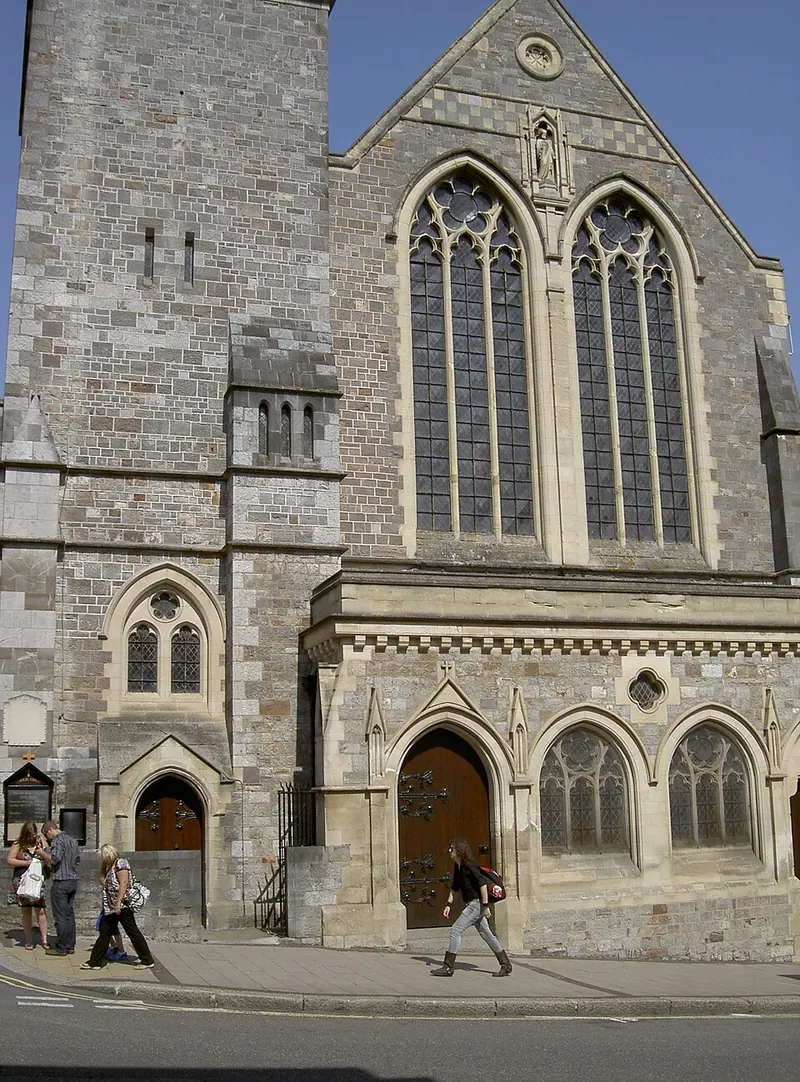
Sacred Heart Church, Exeter is a Roman Catholic church in Exeter, Devon. It is part of the Diocese of Plymouth.
Introduction
The church was built in 1883-4 in the Gothic style by Leonard Stokes in partnership with C E Ware. It is the earliest surviving work of Leonard Stokes, a leading figure in the move towards a freer interpretation of Gothic in the late nineteenth century.
History
Mass was said in Exeter more or less continuously from the mid-eighteenth century in a series of rooms in secular premises. The church is built on the site of the Bear Tavern, the former town house of the Abbots of Tavistock, which became an inn after the Dissolution. The church tower was not completed until 1926; the original design included a spire but this was not added.
The chapel at the Mint served as the mission church in Exeter until the establishment and construction of the Sacred Heart parish church. The Jesuits left the Mint, and it was granted to the Diocese of Plymouth in 1877. A new diocesan priest was appointed to Exeter and left with the task to find a site and build a new church. The site for the new church was purchased in 1873, the site of the old Bear Inn and wagoner's yard, and the neighbouring Georgian townhouse would be remodelled as the presbytery.
Bishop Vaughan of Plymouth laid and blessed the foundation stone in 1883. The main body of the building was completed in 1884, although the tower would only be completed in 1926, and the original proposed spire never constructed. Upon completion in 1884, the church was solemnly opened in the presence of bishops, archbishops, and a great number of clergy and religious. After Vatican II, a re-ordering process began; many of the original interiors were retained, including the later rails, and the altars left untouched.
Architecture and furnishings
The church is constructed of purple grey sandstone with dressings, probably of Bath or Portland stone, under slate roofs with coped gables. The nave has a vaulted roof which was replaced in 1989, and the sanctuary has a seven-sided roof with arched braces. The church has a rich collection of late-19th-century fittings including several ornate reredoses, sanctuary rails with enamel panels, a wrought-iron rood screen, and a large quantity of stained glass. The church has elaborate reredoses in marble and alabaster to the high and side altars designed by Scoles.
A north transept altar has a reredos set against a mural painting of West Country saints by Bernard Collier (1894). The church has a wrought-iron rood screen depicting the crucifixion scene (1886) in the tympanum of the sanctuary arch. A large quantity of stained glass is mostly attributed to Devon glassmaker Frederick Drake; some of the glass in the north aisle was installed in 1934 to commemorate the golden jubilee of the opening of the church. The organ dates from c1893 (restored in 1988) and was built by Hele and Company.
The single bell, hung in 1884, is dedicated to St Boniface. The St Joseph altar was a gift of Mrs Knight of Axminster in 1881, in memory of her deceased husband, named Joseph. The St Joseph altar was first used to celebrate Mass on the 18th of November 1884 by Father Hobson, the first priest of the parish; the altar was not consecrated until 1887.
A window depicting St George, patron of England, was dedicated on his feast day the 23rd April 1933, by the then parish priest Rev. T. Barney, and commemorates Dr George Oliver. Stained glass above the Saint Boniface altar illustrates six episodes in the life of the Saint, and was made by local artists Messrs Gibbons and Blanchford.
The Lady Altar was paid for by public subscriptions and inaugurated on 2 May 1887 (Whitsunday). The original High Altar was fronted with Beer stone, matching the reredos, and depicted three of the Seven Sacraments; neither was complete at the church's opening on 18 November 1884.
The Stations of the Cross were a present from Miss Middleton of London, painted on zinc in Munich with dark oak frames, and installed on 18 April 1886. The old baptistery contains an undated font enclosed by wrought iron gates and rails with the words JANUA COELI, a present by Algernon Bowring in memory of his father Edgar. The organ was built by the local John Hele & Co, whose manager (Mr Thompson), a parishioner, designed the organ case. The small transomed window in the stairway up to the organ loft was recovered from the rubble of the former Bear Inn, dating from 1495.
The tablet in the porch commemorates the first visit of a Papal Legate to Devon, when Cardinal Bourne was welcomed in this Church on 25 August 1932. The statue of Christ the King was brought in 1932 by Fr T. Barney from Clery's showrooms at a Eucharistic Congress in Dublin.
The church escaped serious damage during the air-raids on Exeter in May 1942, with only minor roof damage and the main doors badly scorched by heat. The front altar rails have enamel painted depictions of Christ's suffering and death, with an inscription describing the holy Eucharist. The golden lettering on the altar rails reads “My Flesh Is Meat Indeed” on the left and “My Blood Is Drink Indeed” on the right. The war memorial tablet commemorates those who died in the First World War, with a Mass offered annually on or about 11 November in perpetuity.
Music and liturgy
The congregation organised regular processions and public displays of the faith, including Good Friday processions where a statue of Christ carrying the Cross was paraded through the city. Numerous parish groups serve the liturgy, including groups for music, servers, and readers.
Sacraments and pastoral care
The parish offers Baptism Preparation courses online for parents of children to be baptised. The confessionals are where the Sacrament of Reconciliation takes place, with a central priest's compartment and separate compartments for penitents on each side.
The throne above the High Altar was used during Exposition of the Blessed Sacrament, with the monstrance placed there to be clearly visible. The carvings on either side of the sanctuary depict four of the seven Sacraments: Confirmation, the Eucharist, the Anointing of the Sick and Holy Orders. The alabaster tabernacle, designed by Rev. Alexander Scoles of Bridgewater, was installed on the Feast of Pentecost 1887. The mural depicting James Turberville, last Catholic Bishop of Exeter, was placed in the Sanctuary on the 20th of November 1906.
Four windows were created by John Hardman of Birmingham in 1934, and dedicated by Bishop John Barrett for the Golden Jubilee of the Church. The window depicting St Nicholas distributing alms to the poor reflects Catholic Exeter's long association with St Nicholas, dating back to the founding of St Nicholas' Priory in 1087. The centre window of the Saint Boniface altar shows St Boniface in full bishop's vestments over the scene of his martyrdom, with lettering “St Boniface, Glory of Devon, Apostle of Germany, Martyr”.
Notable people and events
Dr George Oliver served as the priest in Exeter for four decades, coming to the Mint in 1807 after being educated at Stonyhurst College. In 1850, the hierarchy was restored, Exeter was located in the new Diocese of Plymouth, and Dr Oliver given title of provost of the diocesan chapter, although he gave this post up in 1857. Dr Oliver died in 1861 after many years of faithful service to Exeter. The last Catholic Bishop of Exeter, James Turberville, died in prison in 1570 and is immortalised with a wall painting in the sanctuary of Sacred Heart.
Visiting
Sacred Heart had healthy relationships with the cathedral community and the Baptist church on South Street, strengthened during the Second World War. The parish holds an annual International Mass, a sign of its diversity.
The church houses an icon of Our Mother of Perpetual Help, a replica of a Byzantine icon of the Cretan school that has been in Rome since the fifteenth century. The pulpit was the focal point for preaching throughout the greater part of the last century, although it has fallen into disuse for this purpose since the liturgical reforms that followed the Second Vatican Council. The church has a stone statue of St Patrick, patron saint of Ireland.
The stone reredos on the far left of the altar depicts St John Fisher and St Peter, with a panel showing the miracle of loaves and fishes. The central-left panel of the altar reredos depicts the Adoration of the Holy Eucharist by saints and angels. To the far right of the altar the reredos depicts St John the Evangelist and St Cuthbert Mayne, with a panel representing the Manna from Heaven. The mural depicting Christ the High Priest, holding the consecrated bread and wine, was placed in the Sanctuary on 20 November 1906.
Sources for this profile
- Roman Catholic Church of the Sacred Heart, Non Civil Parish - 1223756 | Historic EnglandRetrieved 8 October 2026 Source text © Historic England, licensed under Open Government Licence v3.0. Summarised by RomanCatholic.co.uk.
- Sacred Heart and modern Catholic Exeter | Sacred Heart ExeterRetrieved 8 October 2026
- St Joseph Chapel | Sacred Heart ExeterRetrieved 8 October 2026
- Windows | Sacred Heart ExeterRetrieved 8 October 2026
- Reformation until Restoration | Sacred Heart ExeterRetrieved 8 October 2026
- Early history | Sacred Heart ExeterRetrieved 8 October 2026
- Lady chapel | Sacred Heart ExeterRetrieved 8 October 2026
- The Sanctuary | Sacred Heart ExeterRetrieved 8 October 2026
- Stations of the Cross | Sacred Heart ExeterRetrieved 8 October 2026
- Other features | Sacred Heart ExeterRetrieved 8 October 2026
- Having your child baptised | Sacred Heart ExeterRetrieved 8 October 2026
Clergy
- Priest Fr Petroc Cobb (Parish Priest and Hospital Chaplain)
- Deacon Rev Kelvin Russell (Deacon)
- Deacon Rev Brian Bargent (Deacon)
Find Sacred Heart Church, Exeter
Map location for Sacred Heart Church, Exeter
25 South St., Exeter, Exeter, Devon, EX1 1EB