Mass times this week
Regular weekly timetable
Mon
- 10:00
Tue
- 10:00
Wed
- 10:00
Thu
- 10:00
Fri
- 10:00
Sat
- 10:00
- 18:00 Vigil
Sun
- 09:30
- 11:00
Services with timing to confirm
These source labels need parish confirmation before they can be placed on a date.
Parish schedules can change on holy days of obligation.
We do not hold the page these times were published on, so we cannot show you when they were last confirmed. Mass times may change; check with the parish before travelling.
Confession Times
- Saturday
- 5:30pm-5:50pm
- By appointment
- email the office [email protected]
For a private arrangement, please email the office. If you come to the presbytery without making an appointment, there may not be a priest available.
Information sources
About St John the Evangelist, Islington
St John the Evangelist, Islington is a Roman Catholic church in London, Greater London. It is part of the Archdiocese of Westminster.
Introduction
St John the Evangelist in Islington, London, was built in 1841-43 by architect Joseph John Scoles. The church is Neo-Romanesque in style.
History
The mission of St John the Evangelist was established in 1839. Bishop Griffiths laid the foundation stone on 2 October 1841. The church was opened on 26 June 1843 by the Reverend Peter O'Loughlin.
The interior was re-ordered in 1964 and 1973. During the great storm of 1987, the spire next to the presbytery was damaged, requiring expensive repair. In 1850, Father Frederick Oakeley was appointed to the parish. The architect J. J. Scoles was asked to design a new building on land acquired by Dr Griffiths, the Vicar Apostolic of the London District.
Even before the church opened, A. W. N. Pugin attacked the design because Scoles used rounded arches in the 'Anglo-Norman' style rather than pointed arches. At the time of opening, the two towers planned were not built. St John's was constructed swiftly, financed by a small group of Catholics, and built by local Irish labourers. The celebrated Imperial Mass by Haydn was chosen for the opening ceremony, and for the first time since the Reformation the sound of a bell summoning Catholics to Mass was heard in the metropolis. When the towers were eventually completed, Scoles's original plans were changed, making them smaller and not matching.
Architecture and furnishings
The church has a nave, apsidal chancel, and side chapels in the place of aisles, all under a single roof. The church has a principal gabled front to the east, flanked by towers. The church has a later roof of hammer beam construction.
The organ was built by J.W.Walker & Sons in 1963. The organ was awarded a BIOS certificate of historic importance in 2007. The organ was restored by Keith Bance Organ Builders throughout 2005 and 2006.
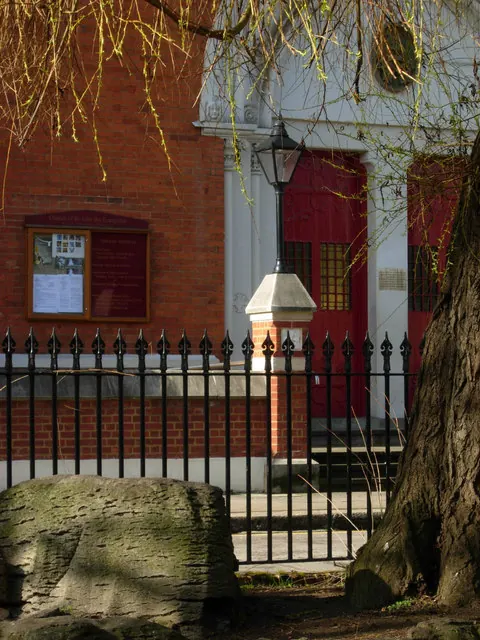
The church is built of red brick in Flemish bond to Duncan Terrace, with yellow brick behind, stone dressings, and a roof of Welsh slate and lead. The south tower is divided into three stages, with engaged columns, a round-arched portal, round-arched windows, a detached belfry stage with brick pilasters, and a pyramidal lead roof. The north tower is higher than the south, with a short third stage of blank brick arcading, a fourth belfry stage with machicolated brickwork, and a broach spire of lead. The interior has round arches with engaged columns and stiff-leaf capitals between the nave and side chapels, and between the nave and the apsidal chancel, and a similar arcade to the clerestory.
The Institution of the Franciscan Order was painted in 1887 to replace an earlier fresco, which had decayed. A painting of Our Lady of Guadalupe, originally from Mexico, was a gift from a parishioner in 2022.
The 1963 organ has a Ruckpositive division hanging over the gallery, which was unique for this country in 1963. The organ at St John the Evangelist, Islington, celebrated its 50th anniversary in 2013.
Music and liturgy
The church's musical tradition began in 1850 under Rector Canon Oakley, with monthly choral and orchestral concerts featuring artists such as Vincent and Clara Novello. The organ was nearly sold to the Royal Academy of Music in the Marylebone Road for installation in the Dukes Hall, but was saved by pressure from various organ bodies. The organ needed a comprehensive renovation by the end of the 1990s, which was hampered by the discovery of asbestos round the RSJ beams supporting the organ. The church has been favoured by many recording companies including the BBC for recordings and broadcasts.
The console indicator 'BBC broadcast' still exists at St John's as a memento of the times when the church was used by the BBC. The theme music for BBC's Songs of Praise was played on the organ from St John's. During the week the organ is used by many for rehearsals and teaching for the benefit of young students from various colleges in London and elsewhere. The organ has 46 stops and is played from three keyboards and pedals.
Parish life
The parish's RCIA programme welcomes people from a wide range of backgrounds and life experiences who share a desire to find God through Catholic faith. The RCIA programme provides a context for a journey in faith, with the group meeting regularly to grow in understanding of Catholic faith and in personal relationship with Christ and his Church.
The GIFT programme is a family catechesis that forms parents and children in their faith side by side, rather than sending children to classes while parents wait outside. The GIFT programme brings families together on Saturday mornings once a month for Mass, fellowship, and shared catechesis, and offers a monthly Zoom session for parents. The GIFT programme is for families with children aged between 5 and 11, and in reality for everyone aged 6 to 106. The organ concert series continues every month from April to September.
Sacraments and pastoral care
The parish runs an Alpha course as an entry point for those completely new to Christianity. Parents new to the parish must complete at least three months of regular attendance at Sunday Mass before their child can be baptised.
For marriage, the Catholic Church requires a minimum of six months’ notice to arrange and prepare a couple. Anyone in danger through sickness or age can ask for the Sacrament of the Anointing of the Sick, and in an emergency when death is imminent, the Presbytery can be phoned at any time. The parish asks that if you are going into hospital, or know of a Catholic in hospital, you inform one of the priests.
Sources for this profile
- Church of St John, Non Civil Parish - 1195583 | Historic EnglandRetrieved 8 October 2026 Source text © Historic England, licensed under Open Government Licence v3.0. Summarised by RomanCatholic.co.uk.
- Our History – St John the Evangelist, IslingtonRetrieved 30 September 2026
- Music – St John the Evangelist, IslingtonRetrieved 8 October 2026
- Chapels – St John the Evangelist, IslingtonRetrieved 8 October 2026
- RCIA – St John the Evangelist, IslingtonRetrieved 8 October 2026
- First Holy Communion – St John the Evangelist, IslingtonRetrieved 8 October 2026
- Curious about Catholicism? – St John the Evangelist, IslingtonRetrieved 6 September 2026
- Baptism – St John the Evangelist, IslingtonRetrieved 8 October 2026
- Holy Matrimony – St John the Evangelist, IslingtonRetrieved 8 October 2026
- Anointing of the Sick – St John the Evangelist, IslingtonRetrieved 8 October 2026
Clergy
- Pastor Séamus O'Boyle
Find St John the Evangelist, Islington
Map location for St John the Evangelist, Islington
39 Duncan Terrace, London, Greater London, N1 8AL