Mass times this week
Regular weekly timetable
Mon
- 12:05
- 17:00
Tue
- 12:05
- 17:00
Wed
- 12:05
- 17:00
Thu
- 12:05
- 17:00
Fri
- 12:05
- 17:00
Sat
- 12:05
Sun
- 09:00
- 11:00
Services with timing to confirm
These source labels need parish confirmation before they can be placed on a date.
See Mass times at the other church in Buckfastleigh →
Parish schedules can change on holy days of obligation.
What the parish's page says
Sung Conventual Mass Monday to Friday: 17:00 Saturday: 12:05 Sunday: 11:00 Sunday Vespers and Benediction: 15:00 Mass in the Blessed Sacrament Chapel Monday to Friday: 12:05 Mass Saturday: No Service Sunday: 9:00
Confession Times
- Saturday
- 11:00–11:30, or by appointment
Adoration & Devotions
Sunday Vespers and Benediction
Sunday 15:00
Lauds (Morning Prayer)
Monday to Sunday 07:45
Mattins (Office of Readings)
Monday to Sunday 06:45
Vespers (in Latin plain chant)
18:30 (15:00 on Sunday with Benediction)
Compline
20:00 (in private on Saturday)
Opening Times & Private Prayer
Daily 6.30am–6pm; reopens later for evening worship; closed to general visitors during service times
Information sources
About St. Mary's Abbey, Buckfastleigh
St. Mary's Abbey, Buckfastleigh is a Roman Catholic church in Buckfastleigh, Devon. It is part of the Diocese of Plymouth.
Introduction
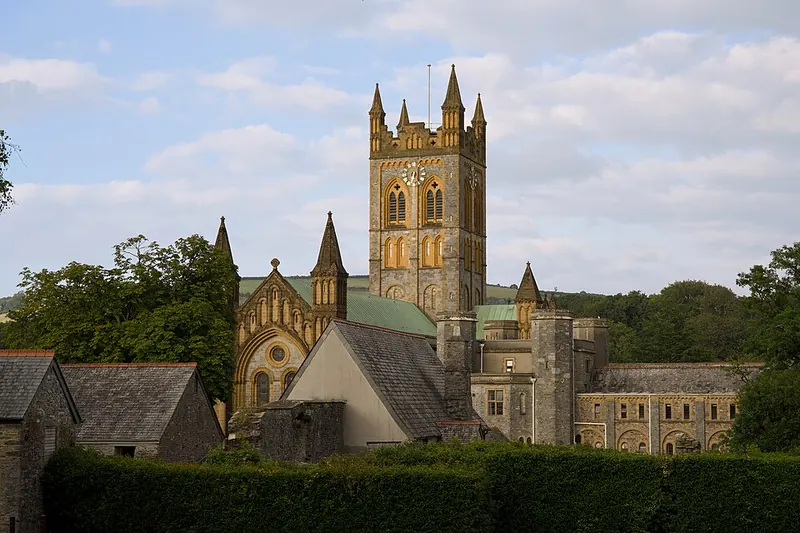
Saint Mary's Abbey in Buckfastleigh was built for the Benedictine monks who established a house there in 1882. According to Pevsner, the church's style is a mixture of English Cistercian and French early Gothic.
History
The first monastery at Buckfast was founded in 1018 during the reign of King Cnut and was Benedictine. In 1136 King Stephen gave Buckfast to the Abbot of Savigny, who sent a monk to establish the Savignac rule. Buckfast became a Cistercian abbey in 1147, and the whole monastery was rebuilt in stone. The arch of the north gate and part of the barrel-vaulted undercroft are the only buildings to survive above ground from the original twelfth century Cistercian abbey.
In 1800 Samuel Berry bought the site, cleared most of the rubble, and built a mansion house, retaining the Abbot's Tower and the twelfth century undercroft. The first six monks arrived at Buckfast on 28 October 1882, with the remainder arriving during the next few weeks. A temporary church, now the Chapter House, was opened on 25 March 1884. In 1902 Buckfast finally became an Abbey again, and the first Abbot elected was Dom Boniface Natter.
Boniface Natter was blessed as Abbot on 24 February 1903, exactly 365 years after the closure of the medieval Abbey. Work on the Abbey Church started in earnest after Anscar Vonier's election as Abbot in September 1906. The Abbey Church was built piecemeal by a small group of monks, normally only four and never more than six, beginning with the east end, sanctuary, transepts and two bays of the nave. In 1910, Sir Robert Harvey donated a peal of fourteen bells to the Abbey in memory of his wife, Alida.
The Abbey Church was consecrated on 25 August 1932, with Cardinal Bourne as the Pope's representative, five Archbishops, sixteen Bishops, thirty Abbots and many priests taking part. The final stone was laid on the tower on 24 July 1937, completing thirty-two years of work. In 2011 an exhaustive cleaning, conservation and restoration of the church's exterior and interior was begun, and in 2013-14 a new floor of Purbeck stone and a further section of Cosmati flooring around the altar were laid. The discovery and excavation of the medieval foundations in 1883 radically altered F. A. Walters' proposed plan for the Abbey's restoration.
The building work continued throughout the First World War, during which time the community, two-thirds of whom were German, were prohibited from leaving the monastery without special licence. In 1966 the new Blessed Sacrament Chapel was inaugurated.
Architecture and furnishings
The church has a stone-vaulted interior with aisles with transverse vaults, and a nave rib vault with red sandstone infill. The church contains outstanding metalwork, mostly 1928-1932 by Bernhard Witte of Aachen, inspired by German Romanesque metalwork. The church contains a C16 ivory crucifix donated by the Clifford family of Ugbrooke, the leading Roman Catholic family in Devon. The church is built of snecked local grey limestone with Ham Hill dressings and a copper roof.
The plan includes 8-bay lean-to aisles, a galleried western bay, a central crossing tower, transepts with chapels, a 3-bay choir with choir aisles, and an east end Blessed Sacrament chapel with undercroft. The west end of the nave has flanking projecting buttresses containing stairs to the gallery, rising as pinnacles with broach spire roofs, with bases and pinnacles decorated with blind arcading. The round-headed west doorway has shafts with cushion capitals and a carved gable, and the doorway has 3 orders of zigzag, billet and chevron moulding on engaged shafts.
The north side of the 9-bay nave has pilasters and a corbelled parapet, with round-headed triforium windows linked by a string rising as a continuous hoodmould. The north end of the north transept has tall paired arches containing 4 tiers of glazed blind and glazed windows, either round-headed or roundels. The tower has 3 stages above the nave roof, with clasping pilasters, corner pinnacles with 2 tiers of blind arcading and broach spires, and a crow-stepped parapet. The triforium has a pair of 2-light pointed arches to each bay with a super-ordinate round-headed blind arch.
The crossing has a corbelled stone gallery, and the transepts have simple galleries on moulded corbels with cast-iron railings. The east end of the sanctuary has 2 round-headed arches and 2 round-headed windows above the triforium with a central shaft rising to a carving of the Coronation of the Virgin. The stained glass is a remarkable collection, mostly still in the medievalising Victorian tradition and of the highest quality.
Music and liturgy
The Abbey Choir in its present form was founded in 2009 and attracts semi-professional singers from across the region and beyond. Buckfast has created its own record label, Ad Fontes, dedicated to presenting recordings of the finest sacred music, specialising in choral and organ music with a focus on the Choir of Buckfast Abbey and the new Ruffatti organ. The community celebrates the divine liturgy according to the rites of the Roman Catholic Church as its principal way of proclaiming the Good News.
Parish life
The Education Department was created in 1985 to develop facilities for schools wishing to visit the Abbey and find out more about its life. In 1993, the Southgate Retreat Centre was blessed and opened, providing hospitality for groups and individuals who wished to stay at the Abbey. St Cuthbert's Conference Centre, located on the site of the former school, has become an integral part of Buckfast's ministry of welcome.
The Buckfast Abbey Bee Department switched to education in 2010 and began to deliver courses and workshops for those interested in honeybees and beekeeping. A community beekeeping group has been created with the intention of making beekeeping accessible to a greater range of people. The bee department runs beekeeping courses and honeybee experience days, as well as hosting visits from groups and individuals from all over the world. The bee department offers a wide range of talks which can be delivered in person or by Zoom.
The community beekeeping group provides an opportunity for a more informal interaction with bees including gardening for pollinators and other group activities. The monastic community celebrates the Divine Office and Mass together each day in the Abbey Church. Mass is live streamed from the Abbey Church every Sunday. The Oblates are an important part of the Buckfast community, sharing the same Divine Office (in part or in full), which St Benedict calls 'the Work of God.'
Sacraments and pastoral care
The parish prepares children for First Holy Communion, continuing the faith journey started at baptism. Confirmation normally takes place when a child is aged 14, and Catholic adults may be confirmed at any age after preparation. Confessions are heard in the Abbey Church on Saturdays. Couples who are free to marry are normally expected to have some connection with the Abbey and are prepared for marriage before making their vows.
Visiting
The Monastic Way Exhibition is an immersive presentation of Benedictine monastic life, from its origins to the present day. The Gift Shop sells indoor and outdoor plants curated to align with the garden themes at the Abbey, and also sells tickets for the Monastic Way Exhibition. Toilets are located in the car park and below the Grange Restaurant.
Sources for this profile
- Church of St Mary (Buckfast Abbey) , Buckfastleigh - 1209774 | Historic EnglandRetrieved 8 October 2026 Source text © Historic England, licensed under Open Government Licence v3.0. Summarised by RomanCatholic.co.uk.
- Buckfast History – Buckfast AbbeyRetrieved 24 September 2026
- Liturgy – Buckfast AbbeyRetrieved 8 October 2026
- Bees – Buckfast AbbeyRetrieved 8 October 2026
- Service Times – Buckfast AbbeyRetrieved 24 September 2026
- Oblates – Buckfast AbbeyRetrieved 8 October 2026
- Sacraments – Buckfast AbbeyRetrieved 8 October 2026
- what to do – abbey church – Buckfast AbbeyRetrieved 8 October 2026
Find St. Mary's Abbey, Buckfastleigh
Map location for St. Mary's Abbey, Buckfastleigh
Buckfast Abbey, Buckfastleigh, Buckfastleigh, Devon, TQ11 0EE