Mass times this week
Regular weekly timetable
Mon
- 08:00
- 10:30
- 12:30
- 17:30
Tue
- 08:00
- 10:30
- 12:30
- 17:30
Wed
- 08:00
- 10:30
- 12:30
- 17:30
Thu
- 08:00
- 10:30
- 12:30
- 17:30
Fri
- 08:00
- 10:30
- 12:30
- 17:30
Sat
- 08:00
- 10:30
- 12:30
- 18:00 Vigil
Sun
- 08:00
- 10:00
- 12:00
- 17:30
- 19:00
Services with timing to confirm
These source labels need parish confirmation before they can be placed on a date.
See Mass times at the 345 other churches in London →
Parish schedules can change on holy days of obligation.
What the parish's page says
Sunday: 8am, 10am (sung), 12 noon (solemn, livestream), 5.30pm (sung), 7pm; Monday – Friday: 8am, 10.30am (Latin), 12.30pm (livestream), 5.30pm (solemn); Saturday: 8am, 10.30am (Latin, solemn), 12.30pm (livestream), 6pm (sung Vigil)
Confession Times
- Sunday
- 10:30–12:30, 17:00–18:30
- Monday–Friday
- 11:30–12:30, 16:30–17:30
- Saturday
- 11:30–12:30, 17:00–18:00
Opening Times & Private Prayer
Cathedral open daily 07:30–19:00.
Languages & Rites
Latin Mass
Monday–Friday 10:30; Saturday 10:30 (solemn).
Information sources
About Westminster Cathedral
Westminster Cathedral is a Roman Catholic church in London, Greater London.
History
The work was financed through a Founders scheme, with individuals pledging £1000 or more; early donors included the Duke of Norfolk, Fr Hugh Benson, GK Chesterton and Hilaire Belloc. The consecration ceremonies extended over three days from 27 to 29 June, the feast of SS Peter and Paul. The ceremonies began on 27 June with Exposition of the Relics, and the altars were consecrated on 28 June with silver caskets inserted into each altar. Bentley's name is not recorded in the cathedral; the building alone is his monument.
Architecture and furnishings
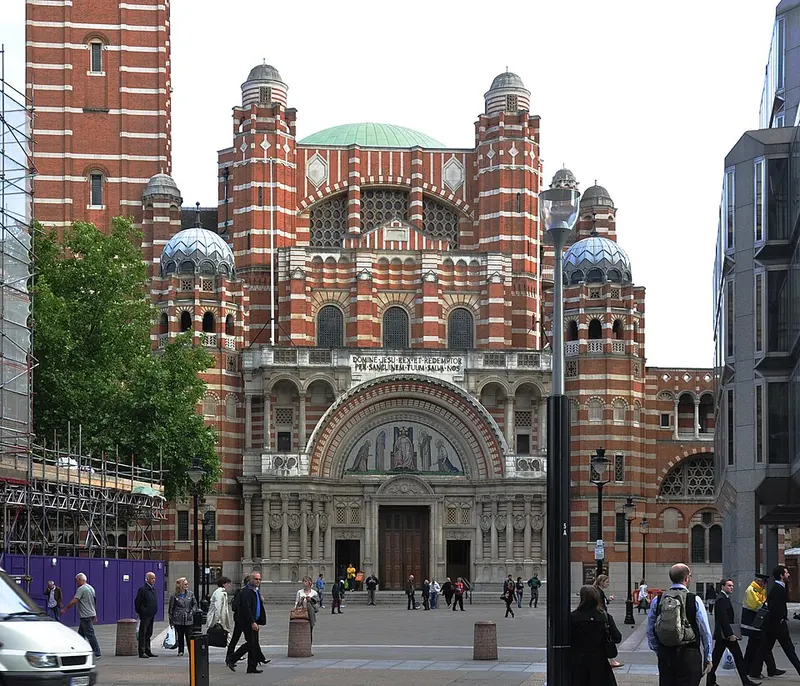
The cathedral is built of red brick with Portland stone bandings and dressings on a Cornish granite plinth, with concrete foundations and vaults. The narthex has columns of Norwegian granite and a marble floor, with an organ by Henry Willis and Sons over. The nave has broad galleries over aisles, supported at the centre of each bay by paired monolithic columns, each Carrara marble capital being a different design. The high altar is of Cornish granite, with a baldacchino of Veronese marble on a marble floor, designed by Bentley in 1901 and executed by Farmer and Brindley in 1905-6.
The piazza was opened up in the 1970s, revealing the full impact of the building. The Stations of the Cross are by Eric Gill, 1913-18. The pulpit was remodelled and enlarged in 1934 by L H Shattock. The Chapel of the Holy Souls was completed to Bentley's fully worked out designs, in black and white marble and with mosaics by Christian Symons 1902-3.
The Chapel of St George and the English Martyrs was developed as a war memorial from 1915, largely designed by Marshall with altarpiece by Eric Gill, 1946. The Chapel of St Gregory and St Augustine has an altarpiece by Henry Holliday set into a design by Bentley, with mosaics by Clayton and Bell 1902-4. The Chapel of St Patrick and the Saints of Ireland, clad in Irish marbles with memorials to the Irish regiments of 1914-18, was designed by Marshall in the 1920s; the altar also by him, 1910. The Chapel of St Andrew and the Scottish Saints was the gift of Lord Bute and the work of R Weir Schultz 1910-14, with stalls by Ernest Gimson and kneelers by Sidney Barnsley.
The Chapel of St Paul is similar to Marshall's work for that to St Joseph, 1913-17. A mosaic of St Joan of 1909-12 by Christian Symons is in the north transept, where also is the Chapel of St Thomas of Canterbury - the Vaughan Chantry. The Blessed Sacrament Chapel was marble clad between 1904 and 1909, enclosed by grilles and gates 1907 by Marshall, with mosaics by Boris Anrep completed in 1962. The Lady Chapel is clad in richly-coloured rare marbles, completed c.1914, with a white marble altar and a mosaic of Our Lady with the Holy Child by Anning Bell.
The altar cross of gilt bronze and enamel was designed after Bentley's death by the firm he founded, Bentley, Son and Marshall, and was used for the first time at the Mass of Consecration in 1910. The so-called Henry VIII chalice, made in London in 1529, was presented to the Cathedral by Baron Antonio French and his sisters Georgine and Blanche. A monstrance dating from 1907 was gifted to the Cathedral by a novice of the Poor Clares of Amiens.
The Willis Grand Organ in Westminster Cathedral is considered by many to be the greatest achievement of Henry Willis III. The cathedral was built between 1895 and 1903 to the designs of J F Bentley and consecrated in 1910. Saucer domes of brick and concrete cover the nave in three places and the sanctuary in one. The architectural style is free Byzantine.
The west facade has a central entrance in a semi-circular arch with decorative voussoirs, columned jambs, a mosaic by Robert Anning Bell in the tympanum, and sculptured medallions of 12 Archbishops of Canterbury. Bentley resisted the use of iron in architecture, and the three great domes are constructed from concrete.
Over 100 different varieties of marble decorate the interior, sourced from 24 countries. The six yellow marble columns of the baldachino over the High Altar came from Verona. The lighting pendants of the nave were erected in 1909.
The baptistery has a font by Bentley. The Chapel of St Joseph has a fine altar by Marshall.
Music and liturgy
The choir is widely regarded as one of the finest in the world, singing daily liturgy in the Cathedral and making award-winning recordings and international tours. The choir owes its existence to Cardinal Herbert Vaughan, Archbishop of Westminster from 1892 to 1903. The new Cathedral Choir School welcomed its first boys in 1901. A year later, 25 boys and 16 men were ready to sing their first services in the Cathedral Hall, as the Cathedral itself was not opened until the following year.
The choir's workload was immense, with daily Mass and Vespers as well as high-profile events such as the Cathedral's Consecration in 1910. It was twenty-three years after Terry's departure that another legendary figure, George Malcolm, was appointed to Westminster Cathedral. Fascinated by the natural timbre of boys' voices, George Malcolm recreated the choir's sound in a bright, 'continental' style, with the boys once said to have had 'voices like razors'. Benjamin Britten was so inspired when he heard the Westminster Choristers singing his Ceremony of Carols that he decided to write his Missa brevis in 1959, joining the likes of Vaughan Williams, Holst, and Howells in writing new music for the choir.
An old chorister who frequently played the organ for services as a boy, Mawby steered the ship through the difficult years after the Second Vatican Council, composing prolifically for the choir in both Latin and English. In 1979, Sir Stephen Cleobury was the first Anglican to be appointed Master of Music, and his clear-thinking and methodical approach laid firm foundations for the future of the Cathedral's music.
Comprising up to 20 boy trebles and altos aged 8-13 and ten professional Lay Clerks, the choir was founded in 1901 and remains the only Catholic cathedral choir in the world to sing daily Mass and Vespers. The choir is internationally renowned for polyphony and plainchant.
Parish life
Westminster Cathedral is at the heart of Catholic faith in London, with Mass celebrated throughout the day every day and the Sacrament of Reconciliation available daily. The Friends of Westminster Cathedral provide essential financial support for the music, fabric and maintenance of the building and serve as a focal point for the worldwide community of supporters.
Supporters can make a one-off donation, set up a standing order, or become a member of the Friends of Westminster Cathedral and take part in fundraising events. Adults interested in joining the Church follow a six-month course, the Rite of Christian Initiation of Adults, culminating at the Easter Vigil Mass when they receive the Sacraments of Baptism, Confirmation and Holy Communion.
A daily rota ensures at least one priest is available to hear Confession during advertised hours. Chaplains administer the Sacrament of Anointing to those in need, in the Cathedral and during home visits. Many couples in the parish wish to marry at the Cathedral, with the Lady Chapel being an especially popular wedding venue.
The Guild of St John Southworth volunteers meet visitors at the Cathedral, answer queries and give brief tours of the Cathedral highlights. The Cathedral's monthly magazine Oremus and weekly newsletter are available in large print versions upon request.
Sacraments and pastoral care
The candidate group meets regularly with a Cathedral Chaplain, exploring and discussing all aspects of the Catholic faith. The Catholic Church recommends burial; cremation is permitted, but remains must be buried in one location and cannot be divided or scattered.
Notable people and events
Bishop Richard Challoner, the first Catholic bishop to the Americas, was buried in the chapel of SS Gregory and Augustine; his remains were re-interred in Westminster Cathedral in 1946.
Visiting
A lift takes visitors to the Tower Viewing Gallery, which offers a panoramic view of London. An induction loop system is available for visitors who are deaf or hard of hearing. The Cathedral sits in the heart of London's Victoria district, near a major transport hub, with no parking facilities. Bus routes 3, 11, 24, 26, and 148 on Victoria Street serve the Cathedral.
An inscription at the foot of the sanctuary steps recalls the 1981 visit of St John Paul II. A glass casket holds the remains of St John Southworth, a Catholic priest executed during Oliver Cromwell's interregnum.
The Cathedral houses many distinguished artworks, including hundreds of mosaics and Stations of the Cross by sculptor Eric Gill. Licensed security officers conduct regular checks inside and outside the Cathedral, supported by a comprehensive CCTV system.
The Cathedral's bell tower appears dramatically in the finale of Alfred Hitchcock's Foreign Correspondent (1940). The 'Queen's chair' is located in the Chapel of St George and the English Martyrs.
Sources for this profile
- History of the Cathedral - Westminster CathedralRetrieved 8 October 2026
- Westminster Cathedral, Non Civil Parish - 1066500 | Historic EnglandRetrieved 8 October 2026 Source text © Historic England, licensed under Open Government Licence v3.0. Summarised by RomanCatholic.co.uk.
- An Architectural Gem - Westminster CathedralRetrieved 8 October 2026
- Treasures - Westminster CathedralRetrieved 8 October 2026
- Music - Westminster CathedralRetrieved 8 October 2026
- Art, Marbles & Mosaics - Westminster CathedralRetrieved 8 October 2026
- History of the Choir - Westminster CathedralRetrieved 8 October 2026
- Westminster Cathedral -Retrieved 27 September 2026
- Our Community - Westminster CathedralRetrieved 8 October 2026
- Becoming a Catholic - Westminster CathedralRetrieved 8 October 2026
- Sacraments - Westminster CathedralRetrieved 8 October 2026
- Plan your Visit - Westminster CathedralRetrieved 8 October 2026
- Funerals - Westminster CathedralRetrieved 8 October 2026
Clergy
- Assistant Priest Rev Michael Guthrie
- Chaplain Rev Hugh MacKenzie
- Chaplain Rev Patrick van der Vorst
- Chaplain Rev Paul Zhao SVD
- Chaplain Rev Vincent Mbui SVD
- Dean Rev Slawomir Witon
- In Residence Rev Clement Abobo
Find Westminster Cathedral
Map location for Westminster Cathedral
42 Francis Street, London, Greater London, SW1P 1QW